

Introduction
If you’re new to RVing, the electrical side of owning a travel trailer can feel like its own language. Volts, amps, watts, running watts, starting watts, shore power, inverters, converters — the terms pile up fast, and most of them get thrown around without much explanation.
Understanding these terms isn’t just about sounding knowledgeable. It directly affects three things every RV owner cares about: choosing the right generator, avoiding overloaded circuits and tripped breakers, and using your RV’s electrical system safely. A generator that’s sized wrong, an extension cord that’s too thin, or a misunderstanding about what “50-amp” actually means can lead to expensive equipment damage — or worse, a safety hazard.
This guide walks through the core concepts in plain English, then works through a full glossary of the terms you’ll run into most often. By the end, you should be able to read a generator’s spec sheet or your RV’s electrical panel and actually understand what you’re looking at.
Quick Answer
Most RV electrical terminology becomes much easier once you understand a handful of basic concepts: volts, amps, watts, starting watts vs. running watts, and shore power.
In short: volts measure electrical pressure, amps measure the flow of electricity, and watts measure how much power something actually uses (volts × amps = watts). Appliances with motors — air conditioners, refrigerators, pumps — need a short burst of extra power just to start up, which is why generators list both a “running” and “starting” wattage. And “shore power” simply means plugging into a fixed electrical hookup at a campground instead of running your own generator.
Once those pieces click, sizing a generator or understanding your RV’s electrical service becomes a lot less mysterious — which is exactly what the rest of this guide walks through.
RV Electrical Basics: The Five Numbers Every RV Owner Should Understand
Volts
Voltage is the electrical “pressure” pushing electricity through a wire. Think of it like water pressure in a hose — higher voltage means more electrical pressure available to do work.
Most RVs run on two separate voltage systems: 120-volt AC power (the same as a standard household outlet, used for things like your microwave, air conditioner, and wall outlets) and 12-volt DC power (used for your lights, water pump, and other components that run off your battery).
RV example: When you plug your RV into a campground pedestal or run a generator, you’re supplying 120-volt power to your RV’s outlets and appliances. Your RV’s battery bank, on the other hand, runs on 12 volts.
Amps
Amperage measures the rate at which electricity flows — how much current is moving through a wire at any given moment.
This matters because every circuit, breaker, and generator has a maximum amp rating it can safely handle. Exceed it, and a breaker trips (or, in the worst case, a wire overheats).
RV example: Your RV is rated for either 30-amp or 50-amp service. That number tells you the maximum amount of current your RV’s electrical system can draw at once — not how much you’re actually using at any given time.
Watts
Watts measure actual power consumption — how much electricity something is using. Watts are calculated as volts multiplied by amps (Volts × Amps = Watts), which is why you’ll often see all three numbers referenced together on generator and appliance labels.
RV example: A 13,500 BTU RV air conditioner typically draws around 1,500 running watts once it’s up and running — but needs a much larger surge of power just to start the compressor (more on this in the Running Watts vs. Starting Watts section).
Watt-Hours
Watt-hours measure energy over time, not power at a single moment. If watts tell you how much power something uses right now, watt-hours tell you how much total energy it will use over an hour of operation.
This distinction matters most for batteries and solar setups, where capacity is described in watt-hours (or amp-hours) rather than watts.
RV example: A 100-amp-hour, 12-volt battery has a nominal energy capacity of roughly 1,200 watt-hours (100 amp-hours × 12 volts). This is a theoretical maximum, not the amount of energy you can actually use — real-world usable energy is lower once you factor in battery chemistry, safe depth of discharge, temperature, and inverter/system losses. A lithium battery, for example, typically allows a much deeper safe discharge than a lead-acid battery of the same rated capacity.
Amp-Hours (Ah)
Amp-hours are the most common way battery capacity is described — they measure how much current a battery can supply over time, independent of voltage.
RV example: A “100 Ah” battery can theoretically supply 100 amps for one hour, 10 amps for ten hours, or 1 amp for 100 hours. To convert amp-hours into watt-hours (a more direct measure of total energy), multiply amp-hours by voltage — a 100 Ah, 12-volt battery equals roughly 1,200 watt-hours, as covered above.
How RV Power Actually Flows
It helps to think of your RV as having two separate but connected electrical systems.

AC power path (120-volt):
Generator or Shore Power → RV Power Cord → Electrical Panel → Breakers → Appliances
When you plug into shore power or start your generator, electricity travels through your RV’s main power cord into the electrical panel, where individual breakers protect each circuit before power reaches your outlets, air conditioner, and other 120-volt appliances.
Battery/DC power path (12-volt):
Generator/Shore Power → Converter → 12V DC Loads + RV Battery
When you’re connected to shore power or running a generator, the converter changes 120-volt AC power into 12-volt DC power. That power can operate the RV’s 12-volt equipment — lights, water pump, and other 12V components — while at the same time charging the battery. The battery isn’t sitting “in line” between the converter and your 12V loads — both draw from the converter’s output simultaneously, and the battery also supplies 12V power on its own whenever you’re not connected to shore power or a generator.
Solar/battery path:
Solar Panels → Charge Controller → Batteries → Inverter → AC Loads
If your RV has solar panels, they charge your batteries through a charge controller (which regulates the charging so you don’t overcharge or damage the battery). From there, an inverter can convert that stored 12-volt battery power back into 120-volt AC power to run standard household-style appliances without a generator or shore power hookup at all.
The key takeaway: AC and DC power serve different purposes in your RV, and understanding which system a given appliance or component depends on will make troubleshooting — and generator shopping — much easier.
A–Z RV Electrical Glossary
Power Fundamentals
AC Power (Alternating Current)
The type of electricity that flows through standard household-style outlets, where the direction of current flow reverses periodically. This is the power type used by your RV’s air conditioner, microwave, and wall outlets.
Why it matters: Generators and shore power both supply AC power — it’s the standard for most higher-draw RV appliances.
Alternating Current
See AC Power above — the two terms are used interchangeably.
Amp
Short for ampere, the unit that measures the rate of electrical current flow.
RV example: Your RV’s power cord and shore power connection are rated in amps (30-amp or 50-amp service).
Voltage
The electrical “pressure” that pushes current through a circuit, measured in volts. See the RV Electrical Basics section above for a fuller explanation.
Watt
The unit of actual power consumption, calculated as volts × amps. See the RV Electrical Basics section above for a fuller explanation.
Watt-Hour
A unit of energy over time, used mainly for battery capacity and solar generator specifications. See the RV Electrical Basics section above for a fuller explanation.
Kilowatt (kW)
Simply 1,000 watts. Generator output is sometimes listed in kilowatts rather than watts — a “3.5kW generator” is the same as a 3,500-watt generator.
Why it matters: Don’t be thrown off if a spec sheet lists kW instead of W — just multiply by 1,000 to convert.
Frequency (Hz)
Measured in hertz, frequency describes how many times per second AC power reverses direction. Standard U.S. household and RV power runs at 60 Hz.
Why it matters: Sensitive electronics need stable, consistent frequency — part of why inverter generators are recommended for RV use (see Pure Sine Wave below).
Power Factor
A measure of how efficiently equipment uses the power it draws, expressed as a number between 0 and 1.
Why it matters for beginners: You generally don’t need to calculate this yourself — it’s mainly relevant for sizing generators around equipment with electric motors, which most generator sizing charts already account for.
Circuits and Electrical Safety
Breaker
A safety switch that automatically shuts off power to a circuit if it draws more current than the circuit is rated for, preventing overheating or fire.
RV example: If you run your air conditioner and microwave at the same time and exceed your circuit’s amp rating, the breaker will trip and cut power until it’s reset.
Circuit
A complete path that electricity flows through, from the power source, through wiring and a breaker, to an appliance, and back.
Why it matters: Each circuit in your RV has a maximum safe capacity — understanding this helps you avoid overloading one circuit while others sit unused.
Ground / Grounding
Grounding is a safety system that provides a path for fault current and helps ensure protective devices can disconnect power when something goes wrong. The grounding conductor is separate from the normal current-carrying hot and neutral conductors.
Why it matters: Grounding is a core electrical safety system, not an optional feature. Never bypass, remove, or defeat a generator’s or RV’s grounding connection.
GFCI (Ground Fault Circuit Interrupter)
A safety device that monitors the current flowing through a circuit and quickly shuts off power when it detects an imbalance, which can indicate that electricity is taking an unintended path to ground. GFCIs help reduce the risk of electric shock, particularly around water.
RV example: Your RV’s bathroom and kitchen outlets are typically GFCI-protected, and portable generators used for RVs increasingly include built-in GFCI outlets as well.
Neutral
The wire in an AC circuit that carries current back to its source, completing the circuit — working alongside the “hot” wire (which carries current out) and the ground wire (a safety path).
Why it matters: You don’t need to memorize wiring diagrams, but knowing this wire exists helps explain why RV electrical work is best left to qualified technicians.
Extension Cord
A cord used to extend power from a source (generator or shore power pedestal) to your RV, or from your RV to individual devices.
Why it matters: Extension cords are rated for a maximum amp capacity, and using an undersized cord for a high-draw appliance can cause the cord to overheat. Always match or exceed the amp rating you actually need.
Backfeeding
Illegally or unsafely feeding power backward into a building’s electrical system through a standard outlet, instead of through a proper transfer switch — a serious safety hazard.
Why it matters for RV owners: This mainly applies to home backup setups, not typical RV use — but if you ever power a house with a portable generator, always use a proper transfer switch, never a “suicide cord.”
Transfer Switch
A device that safely switches a building’s power source between the utility grid and a generator, preventing backfeeding.
Why it matters for RV owners: Most travel trailers don’t need one — you plug directly into the RV’s shore power inlet. This term matters more if you also use a generator for home backup.
Batteries and Power Storage
Battery Bank
A group of one or more batteries wired together to store electrical energy for your RV’s 12-volt system.
RV example: Many travel trailers come with a single deep cycle battery, though owners who want more off-grid capability often upgrade to a larger battery bank.
Deep Cycle Battery
A battery designed to be repeatedly drained to a significant percentage of its capacity and recharged, unlike a car battery, which is designed for short bursts of high current.
Why it matters: Standard automotive batteries will wear out quickly under typical RV house-battery use — deep cycle (including AGM and lithium) batteries are built for this kind of repeated discharge and recharge cycle.
Power Conversion
Converter
A device that converts incoming 120-volt AC power (from shore power or a generator) into 12-volt DC power, which can run your RV’s 12-volt components directly and charge your battery at the same time.
Why it matters: This is different from an inverter, which does the opposite conversion — see below.
Inverter
A device that converts stored 12-volt DC battery power into 120-volt AC power, allowing you to run standard household-style appliances off your RV’s battery bank without a generator or shore power connection.
RV example: An inverter lets you run a laptop charger or small kitchen appliance off battery power alone, for a limited time, without needing to start a generator.
Pure Sine Wave
A description of the quality and stability of AC power output. Pure sine wave power closely resembles the smooth, consistent power delivered by the utility grid.
Why it matters: Pure sine wave power is generally preferred for sensitive electronics and many modern appliances. Inverter generators and quality inverters typically produce it. Some lower-cost generators and inverters instead produce “modified sine wave” power, which is a rougher approximation of a true sine wave — it isn’t automatically damaging to every device, but it’s worth checking your specific electronics’ manufacturer guidance if you’re relying on modified sine wave power.
Generators
Generator
A device that produces electrical power, typically by burning fuel (gasoline, propane, or diesel) to drive an engine connected to an electricity-generating component.
RV example: A portable generator lets travel trailer owners generate their own 120-volt AC power when camping without shore power access.
Inverter Generator
A generator that uses electronic circuitry to produce clean, stable pure sine wave power, typically while also running more quietly and fuel-efficiently than a conventional generator.
Why it matters: Inverter generators are generally the recommended choice for RV use because of their quieter operation and cleaner power output — see our full comparison in Inverter Generator vs. Conventional Generator.
Dual Fuel Generator
A generator capable of running on more than one fuel type, typically gasoline and propane, giving owners flexibility depending on fuel availability.
Why it matters: Dual fuel generators can be useful for longer trips or areas where one fuel type is harder to find, though they’re often heavier than single-fuel inverter generators of similar wattage.
Parallel Kit
An accessory cable (sold separately from most compatible generators) that allows two same-brand, parallel-capable generators to be connected together, combining their power output.
Why it matters: Parallel capability lets RV owners start with a smaller, lighter generator and add a second unit later if they need more power, rather than buying one large generator upfront.
Load
The total amount of power being drawn by everything currently running on a circuit or generator.
RV example: If your air conditioner, refrigerator, and microwave are all running at once, your total load is the sum of all three appliances’ power draw.
Soft Start
A device installed on (or built into) an air conditioner that reduces the surge of power needed when the compressor starts, by ramping up power gradually instead of all at once.
Why it matters: A soft start can allow a smaller generator to successfully start an RV air conditioner that would otherwise require a much larger generator — though it does not make every generator capable of running every air conditioner. Read more in our Best Soft Start for RV AC guide.
Starting Watts
The brief burst of extra power a motor-driven appliance needs at the moment it starts up, before settling into its normal running power draw. Also called surge watts. Covered in detail in the Running Watts vs. Starting Watts section below.
Running Watts
The steady amount of power an appliance draws once it’s running normally, after the initial startup surge has passed. Covered in detail in the Running Watts vs. Starting Watts section below.
Surge Watts
Another term for starting watts — the temporary spike in power draw when a motor-driven appliance first starts.
Power Sources and Service
Shore Power
A fixed electrical hookup, typically at a campground or RV park, that your RV plugs into directly instead of relying on a generator or batteries.
Why it matters: Shore power is generally more reliable, quieter, and often included in your campsite fee — but it isn’t available everywhere, particularly when boondocking.
Receptacle
The technical term for an electrical outlet — the socket a plug connects to.
RV example: Your RV’s shore power cord connects to a receptacle at the campground’s power pedestal, or to a matching receptacle on a portable generator.
30-Amp RV Service
An RV electrical system rated to draw up to 30 amps at 120 volts, providing a rated capacity of roughly 3,600 watts (30 amps × 120 volts).
Why it matters: Most smaller and mid-size travel trailers use 30-amp service, which is generally sufficient for one air conditioner along with typical appliances, as long as they aren’t all run at maximum draw simultaneously.
50-Amp RV Service
An RV electrical system that uses two separate 120-volt hot legs, together providing up to roughly 12,000 watts of total capacity — significantly more than 30-amp service.
Why it matters: A 50-amp rating means your RV can handle a larger electrical capacity (useful for running multiple air conditioners or several high-draw appliances at once) — but it does not mean you automatically need a generator capable of producing the full 12,000 watts. Generator sizing should be based on what you actually plan to run, not your RV’s maximum service rating. For a deeper look at this, see What Size Generator Do You Need for a 50 Amp RV? and Best Generator for a 50 Amp RV.
TT-30R
A common 30-amp, 120-volt receptacle used for RV connections. Many generators marketed as “RV ready” include a TT-30R outlet so a compatible 30-amp RV power cord can connect directly, without needing a separate adapter.
Why it matters: If a generator doesn’t have a TT-30R outlet, you’ll typically need a dogbone-style adapter to connect your RV’s plug to whatever outlet the generator does have.
TT-30P
A 30-amp, 120-volt RV plug used on the end of a compatible RV power cord. The TT-30P mates with a TT-30R receptacle at a campground pedestal or compatible generator.
NEMA 14-50P
The four-prong, 50-amp plug commonly used on RV power cords. It has two hot legs, a neutral, and a ground.
NEMA 14-50R
The matching four-slot, 50-amp receptacle is used with a NEMA 14-50P plug, including the 50-amp receptacle found on many campground electrical pedestals.
Running Watts vs. Starting Watts
This is one of the most important — and most commonly misunderstood — concepts in RV generator shopping.
What Are Running Watts?
Running watts (also called rated watts) describe the steady amount of power an appliance needs once it’s already running. This is the number you’ll see most prominently advertised on a generator’s specs, and it represents the generator’s continuous power output.
What Are Starting Watts?
Starting watts (also called surge watts) describe the brief burst of extra power a motor-driven appliance needs at the exact moment it starts up — often for less than a second, but the demand is real and generators must be able to supply it or the appliance won’t start at all.
Why Motors Need Extra Power
Appliances with electric motors — air conditioners, refrigerator compressors, water pumps — need significantly more power to overcome the initial mechanical resistance of starting the motor than they need to keep it spinning once it’s already moving. Once the motor is up to speed, power draw drops to the running watts figure.
Appliances without motors (like microwaves, coffee makers, or most lighting) generally don’t have this surge — their starting and running watts are typically the same or very close.
Why Generators Overload
If a generator can’t supply enough starting wattage the instant a motor-driven appliance kicks on, it will typically shut down, trip an internal breaker, or fail to start the appliance altogether. This is one of the most common reasons a generator that “should be big enough” based on running watts alone actually isn’t — the running-watts math checked out, but the starting-watts surge exceeded what the generator could deliver.
Why Generator Manufacturers List Both Ratings
This is exactly why many portable generators list both rated (running) watts and starting (or “peak” or “surge”) watts on their spec sheets. The running watts figure tells you what the generator can sustain continuously; the starting watts figure tells you the maximum brief surge it can supply. When sizing a generator, you need to account for both: enough running capacity for everything you’ll use at once, and enough starting capacity for whichever single motor-driven appliance has the highest startup surge.
How Soft Starts Help
A soft-start device, installed on an RV air conditioner, spreads out the compressor’s startup demand over a longer period instead of drawing it all at once. This can meaningfully reduce the starting watts required to get the air conditioner running.
Importantly, a soft start reduces the starting wattage requirement — it does not increase a generator’s overall capacity, and it doesn’t guarantee compatibility with every generator or every air conditioner. Always check the specific soft-start device’s documented wattage reduction against your actual generator and air conditioner specs.

Running Watts vs. Starting Watts: Example Table
The figures below are approximate examples for illustration only — not universal specifications. Actual wattage varies by brand, model, and operating conditions. Always check your specific appliance’s nameplate or manufacturer specifications before sizing a generator.
| Appliance | Approx. Running Watts | Approx. Starting Watts |
|---|---|---|
| 13,500 BTU RV Air Conditioner | ~1,500 W | ~3,000 W |
| Microwave | ~1,000 W | ~1,000 W |
| Coffee Maker | ~900 W | ~900 W |
| RV Refrigerator | ~180 W | ~600 W |
30-Amp vs. 50-Amp RV Service
30-Amp RV Service
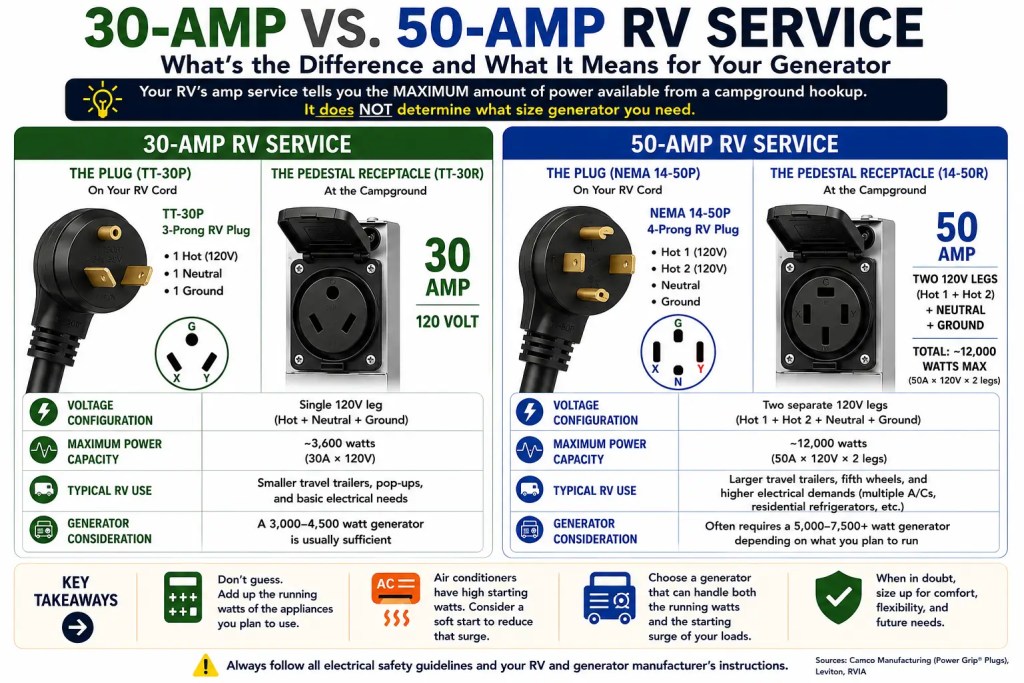
A 30-amp RV connection provides a single 120-volt, 30-amp circuit — providing a rated capacity of roughly 3,600 watts (30 amps × 120 volts). This is common on smaller and mid-size travel trailers.
50-Amp RV Service
A 50-amp RV connection actually provides two separate 120-volt hot legs, plus a neutral and a ground — not a single circuit simply carrying “more amps.” Each of the two hot legs can independently supply up to 50 amps at 120 volts, and together they provide a combined capacity of roughly 12,000 watts (50 amps × 120 volts × 2 legs). This is common on larger travel trailers, fifth wheels, and rigs designed to run multiple air conditioners or other high-draw appliances.
Important beginner point: a 50-amp RV does not mean it’s using 50 amps at 240 volts. RVs use 120-volt appliances throughout — the “50-amp” service simply means you have two independent 120-volt, 50-amp legs available, rather than one.
Beginner Tip: 50-amp service gives you substantially more electrical capacity than 30-amp service — but that doesn’t mean your RV automatically needs a 12,000-watt generator. It means you can run more at once if you choose to. What you actually need depends on what you plan to run simultaneously.
Why a 50-Amp RV Does NOT Automatically Require a 10,000+ Watt Generator
This is one of the most common points of confusion for RV owners, and it’s worth stating plainly: your RV’s amp service rating tells you its maximum electrical capacity — not how much power you actually need.
A 50-amp fifth wheel with two air conditioners doesn’t need a generator capable of the full 12,000-watt theoretical maximum unless the owner plans to run both air conditioners, the water heater, the microwave, and every other high-draw appliance simultaneously at full load — which is rare in practice.
Generator sizing should be based on realistically expected simultaneous appliance use, not your RV’s maximum theoretical service capacity. Some 50-amp RV owners can comfortably operate their planned loads with a generator in the 3,500–5,000 watt range, particularly when running a single air conditioner alongside typical appliances. Others — especially those with larger RVs, dual-air-conditioner setups, or heavier simultaneous loads — may need substantially more power than that range provides. For a full walkthrough of sizing based on your actual usage, see our guides on What Size Generator Do You Need for a 50 Amp RV? and Best Generator for a 50 Amp RV.
30-Amp vs. 50-Amp Comparison
| 30-Amp Service | 50-Amp Service | |
|---|---|---|
| Voltage configuration | Single 120V leg | Two 120V legs |
| Approximate max capacity | ~3,600 watts | ~12,000 watts |
| Typical RV size | Smaller/mid-size travel trailers | Larger travel trailers, fifth wheels |
| Typical use case | One AC unit, standard appliances | Multiple AC units, higher simultaneous load |
| Generator sizing approach | Based on actual planned appliance use, not maximum rating | Based on actual planned appliance use, not maximum rating |
Common Beginner Mistakes
- Confusing running watts with starting watts. Sizing a generator based only on an appliance’s running watts, without accounting for its starting surge, is one of the most common and costly mistakes new RV owners make.
- Buying a generator based only on running wattage. Always check both numbers on the generator’s spec sheet against both numbers for your appliances.
- Assuming every 50-amp RV needs a massive generator. As covered in the 30-Amp vs. 50-Amp RV Service section, your amp service rating is a maximum capacity, not a generator sizing requirement.
- Ignoring air-conditioner startup surge. Air conditioners are almost always the single highest-surge appliance in an RV — size your generator around this number specifically.
- Forgetting that multiple appliances may run simultaneously. Add up the running watts of everything you’d realistically use at the same time, then add the highest single starting-watts figure on top of that total.
- Using an undersized extension cord. A cord rated below the amperage you’re drawing can overheat, even if the generator and RV are both correctly sized.
- Assuming a generator’s maximum wattage is its continuous output. The “starting watts” or “peak watts” figure on a generator is a brief-burst maximum, not a number it can sustain — don’t plan continuous appliance use around it.
- Plugging an RV into an inappropriate power source. Always match your RV’s amp rating and plug type to the power source; don’t use unsafe adapters or bypass safety-rated connections.
- Ignoring campground noise restrictions. Many campgrounds have generator noise limits or quiet hours — check before you arrive, and consider an inverter generator if noise is a concern.
- Forgetting generator ventilation and carbon monoxide safety. Never run a generator inside an enclosed space, including tents, awning-enclosed areas, or vehicles — see the Safety section below.
Generator Specifications You’ll See When Shopping
The A–Z glossary above covers what these terms mean. This section is about something slightly different: helping you actually read a generator’s spec sheet when you’re comparing models side by side.
Most spec sheets will show some combination of the following:
- Rated/running watts and starting/surge watts — the two core power numbers (see the Running Watts vs. Starting Watts section for how to use them together).
- Runtime — how many hours the generator will run on a full tank, usually listed at a specific load percentage (for example, “8 hours at 50% load”). Runtime drops significantly as load increases, so treat advertised runtime figures as a best-case number.
- Fuel tank capacity — directly tied to runtime; a smaller tank means more frequent refueling, which matters for overnight use.
- THD (Total Harmonic Distortion) — lower THD (generally under 3%) indicates cleaner, more stable power, which matters if you’re running sensitive electronics.
- RV-ready outlet / TT-30R — whether the generator includes a dedicated RV-style outlet, or whether you’ll need a separate adapter to connect your RV’s power cord.
- CO shutdown — whether the generator automatically shuts off if it detects dangerous carbon monoxide levels nearby.
- Low-oil shutdown — whether the generator automatically shuts off if oil runs low, protecting the engine.
- Electric start — push-button or key start, versus a manual pull-cord.
- Parallel capability — whether the generator can be connected to a second, compatible unit for combined power output.
- Dual fuel — whether the generator can run on more than one fuel type.
Once you’ve narrowed down a generator based on these specs, proper break-in procedures matter for long-term engine reliability — see our guide on How to Break In a Generator.
For a full breakdown of specific generator recommendations, see Best Portable Generators for Travel Trailers.
Battery and Solar Power
Not every RV owner relies on a gasoline generator, and it’s worth understanding the alternatives briefly.
Battery power stations are essentially large, portable battery packs with a built-in inverter, letting you run AC appliances directly from stored battery power — no fuel, no engine noise, no exhaust.
Solar generators combine a battery power station with solar panels, allowing you to recharge the battery using sunlight rather than plugging into shore power or a generator.
When battery/solar power makes sense: these systems work well for lower-draw needs — charging devices, running lights, powering a laptop or small refrigerator — especially in noise-restricted campgrounds or for owners who prefer not to deal with fuel and engine maintenance.
Why battery power has different limitations than a gasoline generator: a battery system’s capacity is fixed by its watt-hour rating (see the RV Electrical Basics section) — once it’s depleted, you need to recharge it via solar, shore power, or a generator, whereas a gasoline generator can run continuously as long as it has fuel. Battery systems also typically have lower continuous wattage output than gas generators in a comparable price range, which matters if you’re trying to run a full-size RV air conditioner.
If you’re considering this route, our Best Solar Generator for Camping guide walks through specific options and how to think about capacity.
Frequently Asked Questions
What are surge watts?
Surge watts (also called starting watts) are the brief extra burst of power a motor-driven appliance needs at the moment it starts, before settling into its normal running power draw.
Do all appliances have starting watts?
No. Appliances without electric motors — like microwaves, coffee makers, and most lighting — generally draw the same wattage at startup as they do while running. The starting-watts surge mainly applies to motor-driven equipment like air conditioners, refrigerators, and pumps.
What is the difference between watts, amps, and volts?
Volts measure pressure, amps measure current flow, and watts measure actual power consumption (volts × amps = watts). See the RV Electrical Basics section for the full breakdown with RV examples.
What is shore power?
Shore power is a fixed electrical hookup, typically at a campground, that your RV plugs into directly instead of relying on a generator or battery power.
What does a soft start do?
A soft-start device reduces the startup power surge of an RV air conditioner by ramping up the compressor’s power draw gradually, rather than all at once — potentially allowing a smaller generator to start it successfully. It does not guarantee compatibility with every generator, and it doesn’t increase a generator’s overall power capacity.
Can a 2,000-watt generator run an RV?
It depends entirely on what you’re trying to run. A 2,000-watt generator can typically handle lights, charging, a refrigerator, and small electronics, but it will likely struggle to start most RV air conditioners without a soft-start device. See our guide on Can a 2000 Watt Generator Run a Travel Trailer? for a closer look.
What is the difference between a 30-amp and 50-amp RV?
30-amp service is a single 120-volt circuit (~3,600 watts max); 50-amp service is two separate 120-volt legs (~12,000 watts combined). See the 30-Amp vs. 50-Amp RV Service section for the full breakdown, including why this doesn’t directly dictate generator size.
Does a 50-amp RV need a 10,000-watt generator?
Not necessarily — your amp rating is a maximum capacity, not a generator sizing requirement. See the 30-Amp vs. 50-Amp RV Service section for how to size based on what you actually plan to run.
Can I run my RV air conditioner from a small generator?
Possibly, depending on the generator’s starting-watts capacity and whether you use a soft-start device. Most small (2,000–2,200 watt) inverter generators cannot start a typical RV air conditioner without help from a soft start. See our Best Soft Start for RV AC guide for more detail.
What is the difference between an inverter and a converter?
An inverter turns stored battery power into standard AC power; a converter does the opposite, turning incoming AC power into 12-volt DC to run 12V equipment and charge the battery. See the A–Z RV Electrical Glossary above for the definitions of each.
Safety Reminders
RV electrical systems and generators involve real safety risks if handled carelessly. A few reminders worth keeping in mind:
- Carbon monoxide: Portable generators produce carbon monoxide, a colorless, odorless gas that can be fatal — even outdoors, if the generator is placed too close to windows, doors, or vents. For additional portable-generator carbon monoxide guidance, see the U.S. Consumer Product Safety Commission’s generator safety recommendations
- Never run a fuel-burning portable generator inside a travel trailer.
- Never run a generator underneath the RV, inside a storage compartment, in a garage, inside a tent, or in any other enclosed or partially enclosed area — carbon monoxide can accumulate quickly in these spaces, even if they seem “open enough.”
- Keep exhaust directed away from RV doors, windows, vents, and other openings, and always follow your specific generator manufacturer’s placement and clearance instructions rather than relying on a general rule of thumb — clearance requirements vary by model.
- Electrical overloads: Avoid running more appliances simultaneously than your circuit, generator, or extension cord is rated for.
- Grounding: Don’t bypass or remove a generator’s or RV’s grounding connections.
- GFCI protection: Keep GFCI outlets and breakers in place and functional — they protect against electric shock, particularly in wet conditions.
- Extension cord sizing: Use cords rated for at least the amperage you’re drawing, and avoid running cords through water or pinch points.
- Backfeeding: Never attempt to power a building through a wall outlet using a generator — this is dangerous and, in most areas, illegal. Use only your RV’s designated shore power inlet.
- Transfer switches: If you ever use a generator for home backup power (not typical RV use), always use a proper transfer switch.
- Manufacturer instructions: Always follow your specific generator’s and RV’s manufacturer guidance — the information in this guide is general and educational, not a substitute for your equipment’s documentation.
- Campground rules: Check for generator noise limits, quiet hours, and any restrictions before running a generator at a campsite.
Conclusion
RV electrical terminology can feel overwhelming at first, but it comes down to a handful of connected ideas: volts, amps, and watts describe how power is measured; running watts vs. starting watts explains why generator sizing isn’t as simple as matching one number; and understanding your RV’s amp service (30 vs. 50) tells you your system’s capacity — not the generator size you actually need.
Once these pieces click, the rest of RV electrical shopping and troubleshooting becomes far more approachable.
Where to go next:
- If you’re ready to figure out exactly what size generator fits your setup, start with our Generator Sizing Guide or the RV Generator Calculator.
- If safety is top of mind (it should be), read our Generator Safety Checklist.
- If you have a 50-amp RV, see our 50-Amp RV Generator Guide.
- If you’re deciding between generator types, read Inverter Generator vs. Conventional Generator.


