
Introduction
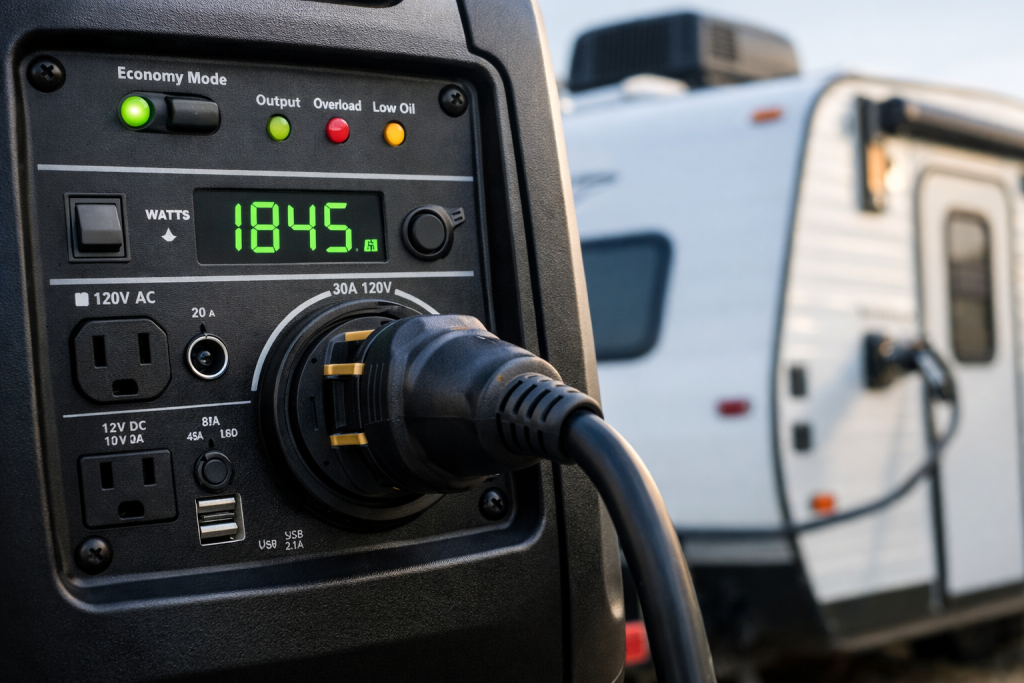
Choosing the correct generator size for your travel trailer is one of the most important decisions you’ll make before hitting the road.
A generator that’s too small won’t power your air conditioner or essential appliances. A generator that’s too large may cost more than necessary and add extra weight and fuel consumption.
In this guide, we’ll break down exactly how many watts most travel trailers need, how to calculate your power requirements, and what generator size works best for different camping styles.
If you’re still comparing specific models, you may also want to review our complete guide to the best trailer generators for travel trailers for detailed product recommendations.
How Much Power Does a Travel Trailer Typically Need?
Most travel trailers require between 2,000 and 4,000 running watts depending on size, appliance usage, and whether air conditioning is being used.
A small travel trailer without air conditioning may only need enough power to run lighting, a refrigerator, battery charger, and small kitchen appliances. In many cases, this can be handled by a 2,000-watt inverter generator.
However, once you introduce a roof-mounted RV air conditioner into the equation, power requirements increase significantly. Air conditioners typically require 1,500 to 2,000 running watts and can demand even more during startup.
The key is not just looking at total wattage, but understanding which appliances will be operating at the same time. A microwave running while the air conditioner cycles on can quickly exceed the capacity of a smaller generator.
Running Watts vs Starting Watts (Why It Matters)
When calculating generator size, understanding the difference between running watts and starting watts is critical.
Running watts refer to the continuous power required to keep an appliance operating. Starting watts — also called surge watts — represent the additional power needed when certain appliances first turn on.
For example:
- A 13,500 BTU RV air conditioner may require 1,500–1,800 running watts
- But it may require 2,500–3,000 watts for a brief startup surge
If your generator cannot handle the surge demand, the air conditioner may fail to start or trip the breaker.
The same concept applies to microwaves, compressors, and certain power tools.
When selecting a generator, always verify that both the running watt capacity and surge watt capacity exceed your expected demand. Ignoring surge requirements is one of the most common reasons campers experience generator frustration.
Generator Size for Running an RV Air Conditioner
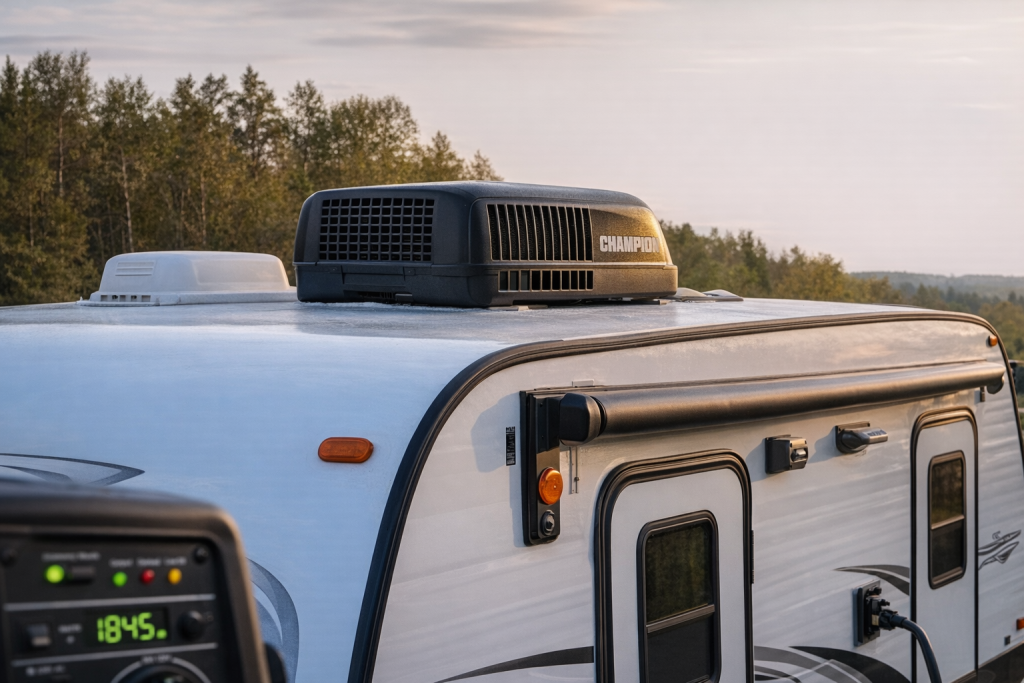
For many travel trailer owners, the primary concern is whether a generator can run the roof-mounted air conditioner.
Most travel trailers use either a 13,500 BTU or 15,000 BTU air conditioning unit.
A 13,500 BTU AC typically requires:
- 1,500–1,800 running watts
- 2,500–3,000 starting watts
A 15,000 BTU AC may require:
- 1,800–2,000 running watts
- Up to 3,500 starting watts
Because of these surge requirements, a 2,000-watt generator is often not sufficient for running an RV air conditioner unless a soft-start device is installed.
In most cases, a 3,000 to 4,000 watt inverter generator provides enough capacity to handle both the AC startup and additional appliances such as a refrigerator or battery charger.
If running air conditioning is a priority, it is generally safer to choose a generator with extra headroom rather than operating at maximum capacity continuously.
Small Trailers vs Large Travel Trailers
Not all travel trailers require the same generator capacity. The size of your trailer plays a major role in determining power needs.
Small travel trailers (under 25 feet) without air conditioning may operate comfortably on a 2,000-watt inverter generator if only basic appliances and battery charging are used.
Mid-size travel trailers with a single air conditioner typically require at least a 3,000-watt generator to safely handle startup surge and normal operation.
Larger travel trailers or dual-AC setups may require 4,000 to 4,500 watts or more, especially if multiple appliances are running simultaneously.
Instead of choosing a generator based solely on trailer length, focus on the actual electrical load your appliances create.
2000W vs 3000W vs 4500W Generators
Choosing between a 2,000W, 3,000W, or 4,500W generator depends largely on how you plan to use your travel trailer.
2,000-Watt Generators
Best for small trailers without air conditioning or for light-duty use. Ideal for battery charging, lights, small appliances, and occasional microwave use. Generally the most portable and fuel-efficient option.
3,000-Watt Generators
A strong middle-ground option for most travel trailers with a single 13,500 BTU air conditioner. Provides enough surge capacity for startup while allowing additional appliances to run safely.
For example, inverter generators in the 3,000–3,500 watt range are often ideal for balancing power and portability for typical RV setups.
4,500-Watt Generators
Better suited for larger travel trailers, higher BTU air conditioners, or campers who regularly run multiple appliances simultaneously. Offers extra headroom and reduces strain during startup.
When in doubt, selecting a generator with slightly more capacity than your minimum requirement provides added flexibility and prevents overload issues.
| Generator Size | Best For | Can Run AC? | Portability |
|---|---|---|---|
| 2000W | Small trailers, no AC | Usually No | Very High |
| 3000W | Most travel trailers | Yes (13.5k BTU) | Moderate |
| 4500W | Larger trailers, heavy use | Yes (15k BTU) | Lower |
Recommended Generator Sizes by Camping Style
The best generator size also depends on how and where you camp.
Weekend Campers
If you primarily camp at established campgrounds and only occasionally run your air conditioner, a 3,000-watt inverter generator is typically the safest and most versatile option.
Boondockers
Off-grid campers who rely heavily on generator power for extended periods often benefit from 3,000 to 4,500 watts to handle sustained use and multiple appliances.
Minimalist Campers
If you rarely use air conditioning and only need power for charging batteries and small appliances, a lightweight 2,000-watt inverter generator may be sufficient.
Smaller campers who only need power for lights, charging, and small appliances may also benefit from portable battery power stations. See our guide to the best solar generators for camping.
For specific model recommendations in each category, see our detailed comparison guide to the best trailer generators for travel trailers.
Final Recommendation
For most travel trailer owners, a 3,000-watt inverter generator provides the best balance of power, portability, and flexibility.
It typically offers enough surge capacity to handle a 13,500 BTU air conditioner while still remaining campground-friendly in terms of noise levels. It also leaves room to operate small appliances without constantly pushing the generator to its limit.
If your trailer is larger, uses a 15,000 BTU air conditioner, or you frequently run multiple appliances at once, stepping up to a 4,000–4,500 watt generator can provide valuable headroom and reduce strain.
Ultimately, selecting a generator that exceeds your minimum requirements slightly will result in a smoother and more reliable camping experience.