

Best Portable Generators for Travel Trailers (Quiet & Lightweight)
Choosing the right portable generator for a travel trailer can be confusing, especially for first-time owners. Noise limits, power requirements, and generator weight all play an important role when selecting a unit that will work reliably at campsites or while boondocking.
This guide explains the best portable generators for travel trailers based on quiet operation, usable power output, portability, and overall reliability. It also explains how to choose the right generator size depending on your trailer’s electrical needs.
If you’re planning to camp in quiet campgrounds, you’ll want to see our guide to the quietest generator for camping.
The goal is simple: help you select a generator that runs what you need, stays campground-friendly, and avoids unnecessary problems.
Quick Comparison: Best Portable Generators for Travel Trailers
If you’re short on time, the comparison table below highlights our top generator recommendations for different travel trailer owners.
| Category | Generator Model | Running Watts | Starting Watts | Noise Level | Weight | Fuel Type |
|---|---|---|---|---|---|---|
| Best Overall | Honda EU2200i | 1,800 | 2,200 | 48–57 dB | 47 lbs | Gasoline |
| Best Budget Step-Up | Westinghouse iGen2500 | 2,200 | 2,500 | 52 dB | 48 lbs | Gasoline |
| Best for RV Air Conditioners (Dual Fuel) | Champion 4500 Dual Fuel Inverter | 3,500 | 4,500 | 61 dB | 95 lbs | Gas/Propane |
| Best Compact / Basic Power | WEN 56225i | 1,800 | 2,250 | 53 dB | 48 lbs | Gasoline |
| Best Lightweight RV-Ready | Champion 4000W RV Ready (100809) | 3,000 | 4,000 | 64 dB | 49 lbs | Gasoline |
Quick Tip
Most travel trailers without air conditioning can be powered by a quality 2,000-watt inverter generator. If you plan to run a 13,500 BTU or 15,000 BTU roof air conditioner, you’ll typically need a 3,500–4,500 starting watt generator, unless you’ve installed a soft start.

Which Generator Is Right for You?
Answer a few simple questions below to quickly narrow down the best generator for your camping style and power needs.
Choose the Honda EU2200i if…
- You want maximum reliability.
- Quiet operation is your top priority.
- You don’t mind paying more.
Choose the Westinghouse iGen2500 if…
- You want more power without spending Honda money.
- You’re looking for the best value.
Choose the Champion 4500 Dual Fuel if…
- You want to run your RV air conditioner.
- You like propane flexibility.
Choose the WEN 56225i if…
- You need lights, charging and electronics.
- You’re on a tighter budget.
Choose the Champion 100809 if…
- You lift your generator often.
- You want an RV-ready outlet.
- Portability matters most.

How to Choose the Right Generator for a Travel Trailer
When selecting a generator for your travel trailer, several factors should be considered.
Power requirements
- Small trailers may only need 1500–2000 watts for lights, battery charging, and electronics
- Running a roof air conditioner often requires 3000–4500 watts
Noise restrictions
- Many campgrounds enforce generator noise limits
- Inverter generators are typically much quieter than traditional open-frame generators
Weight and portability
- Generators under 50 pounds are easier to move and store
- Larger generators may include wheels but are harder to lift into a truck or storage compartment
Inverter vs conventional generators
- Inverter generators produce cleaner power for electronics
- They are usually quieter and more fuel efficient
Parallel capability
- Some generators allow two units to be connected together
- This provides additional power while maintaining portability
If you have a larger RV, see our guide explaining what size generator for a 50 amp RV.
Best Portable Generators for Travel Trailers
How We Chose These Generators
Every generator on this list was evaluated against the criteria that matter most for travel trailer owners, not general camping or job-site use:
- RV suitability — does it include a dedicated RV-ready outlet, and can it realistically support common travel trailer loads?
- Reliability — consistent performance and reputation across verified owner reviews, not just marketed specs
- Noise level — measured or independently tested decibel ratings, since campground courtesy matters
- Weight and ease of transport — how practical it is to lift in and out of a truck bed or storage compartment trip after trip
- Availability — whether the model is currently in production and easy to purchase
- Overall value — the balance of price, power, and portability for the specific needs of RV owners
We prioritized generators that are genuinely suited to travel trailer use over ones that simply have the highest wattage or lowest price.
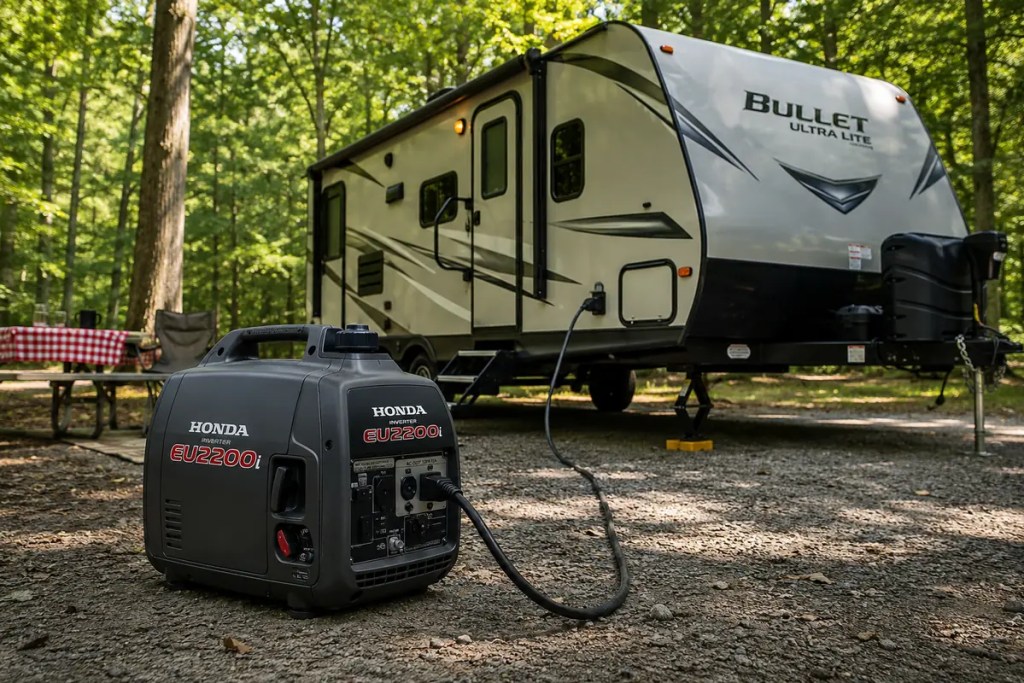
1. Honda EU2200i — Best Overall
The Honda EU2200i is widely considered one of the most reliable portable inverter generators available. Its quiet operation and consistent power output make it a common choice for RV and travel trailer owners.
Pros
- Extremely quiet operation
- Reliable engine performance
- Lightweight and easy to transport
- Parallel capability available
Cons
- Higher price than many competitors
- Limited power for larger trailers with air conditioning
2. Westinghouse iGen2500 — Best Budget Step-Up
The Westinghouse iGen2500 is the updated version of the earlier iGen2200, offering 2,200 running watts and 2,500 starting watts — a genuine capacity increase in the same compact, lightweight body. It’s suitable for travel trailers that need a bit more headroom than the smallest inverter generators provide, such as running a mini-fridge alongside lights and electronics.
Pros
- More running capacity than the smallest inverter generators
- Still compact and lightweight for its output
- Parallel capable
Cons
- Slightly louder than the smallest inverter models
- Build quality reviews are mixed compared to Honda
3. Champion 4500 Dual Fuel Inverter — Best for RV Air Conditioners (Dual Fuel)
The Champion 4500 Dual Fuel inverter generator provides significantly more power than smaller portable generators. This allows it to start and run many travel trailer air conditioners.
Pros
- Higher wattage capacity
- Dual fuel capability (gasoline or propane)
- Electric start
Cons
- Much heavier than smaller generators
- More difficult to transport
4. WEN 56225i — Best Compact / Basic Power
The WEN 56225i is another small inverter generator designed for light loads. It is often used for charging batteries, running lights, and powering small electronics.
Pros
- Lightweight design
- Affordable price
- Parallel capable
Cons
- Limited wattage capacity
- May struggle with larger appliances
5. Champion 4000W RV Ready (100809) — Best Lightweight RV-Ready
The Champion 100809 earns this spot for one reason travel trailer owners will feel immediately: it weighs about 49 pounds — less than half the weight of comparable generators in its power class — while still delivering 3,000 running watts and 4,000 starting watts through a dedicated 30A TT-30R RV-ready outlet. That combination of lightweight design, genuine RV-specific wiring, and real portability makes it easier to lift in and out of a truck bed or trailer storage compartment than most generators in this wattage range. It has enough headroom for common travel trailer needs like lights, electronics, and small kitchen appliances — always check your specific appliance wattage requirements before relying on it for larger loads.
Pros
- Significantly lighter than comparable 3,000–4,000W inverter generators
- Dedicated 30A TT-30R RV-ready outlet — no adapter needed
- 3-year limited warranty with free lifetime technical support
- Clean power (under 3% THD) safe for sensitive electronics
Cons
- Runs at 64 dBA — slightly louder than the smallest inverter models on this page
- Smaller fuel tank (1.54 gal) means more frequent refueling under heavy load
Generator Noise Levels Explained
Generator noise levels are typically measured in decibels (dB). Most inverter generators operate between 48 and 60 dB, which is similar to normal conversation.
Inverter generators are ideal if you need a quiet generator for camping without disturbing others.
Several factors influence generator noise.
Inverter generators
- Designed with enclosed housings
- Variable engine speed reduces noise
Open-frame generators
- Often produce 65–75 dB or more
- Typically louder and less campground-friendly
Many campgrounds restrict generator noise or limit generator hours, making quieter inverter generators a better option for travel trailer owners.
How Big of a Generator Do You Need for a Travel Trailer?
Generator size depends primarily on the appliances you plan to run.
Typical travel trailer power requirements include:
Basic trailer use
- Battery charging
- Lights
- Refrigerator controls
- Small electronics
These loads usually require 1500–2000 watts.
Running a roof air conditioner
Most travel trailers use 13,500 BTU or 15,000 BTU air conditioners. These units often require 3000–4500 starting watts.
Because of startup surge, many RV owners either:
- Use a larger generator (3500–4500 watts)
- Run two smaller generators in parallel
Soft start devices can also reduce the starting wattage required for an air conditioner.
If you’re trying to run an RV air conditioner, you may want to read our full guide on Can a 13,500 BTU RV Air Conditioner Run on a Generator.
If you are unsure what size generator you need, start with our Generator Sizing Guide for Travel Trailers.
Frequently Asked Questions
Can a portable generator run a travel trailer air conditioner?
Yes, but it depends on generator size. Many air conditioners require 3000 watts or more to start.
How quiet does a generator need to be for campgrounds?
Many campgrounds prefer generators under 60 dB, which is typical for inverter generators.
Can a generator damage a travel trailer?
Poor-quality generators can produce unstable power. Inverter generators provide cleaner electricity that is safer for electronics.
Is dual fuel worth it for RV generators?
Dual fuel generators allow the use of propane or gasoline, which provides flexibility when camping or traveling.
Conclusion
Choosing the right generator for a travel trailer depends on your power needs, noise limits, portability requirements, and the appliances you plan to run. For many RV owners, a quiet inverter generator offers the best balance of reliability, efficiency, and campground-friendly operation.
Still not sure which generator is right for your trailer? Start with our RV Generator Calculator or Generator Sizing Guide to determine the generator size you need before making your purchase.
If you’re considering a smaller generator, you may also want to read Can a 2000 Watt Generator Run a Travel Trailer?
If you have a larger RV or a 50-amp electrical system, see our guide on What Size Generator Do You Need for a 50 Amp RV?


