

Introduction
If you’re comparing an inverter generator vs conventional generator, you’ve probably noticed a pattern. Almost every RV-friendly model is an inverter generator, while many larger portable generators are conventional generators. Almost every big, inexpensive generator at the hardware store is a “conventional generator.” That’s not a marketing accident — the two technologies produce power in fundamentally different ways.
That difference determines how loud a generator is, how safe it is for your electronics, how far a tank of gas will take you, and whether it belongs anywhere near your travel trailer. This guide breaks down how each type works, where each one genuinely excels, and why nearly every generator we recommend on this site for RV use is an inverter model — without pretending conventional generators don’t have their place.
If you’re still deciding how much power you need, start with our Generator Size Guide before choosing between generator types.
Quick Answer
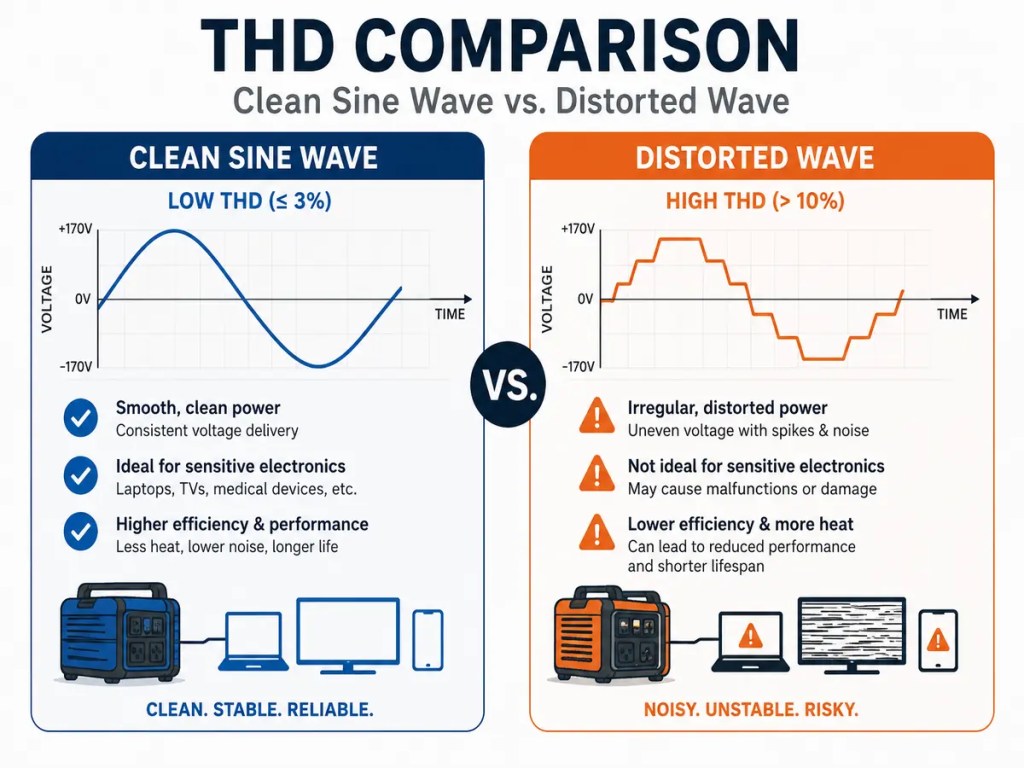
Inverter generators produce clean, stable power (typically under 3% total harmonic distortion) using electronic circuitry. They run quieter and are more fuel-efficient because their engine speed adjusts to the load. Conventional generators spin a standard alternator at a fixed 3,600 RPM regardless of load, which makes them louder and less fuel-efficient, and generally not recommended for powering sensitive electronics without additional power conditioning. They’re also cheaper per running watt and better suited to large, continuous power draws like home backup or job-site tools. For travel trailer and RV use, inverter generators are the right choice in nearly every scenario.
Quick Recommendation for RV Owners
For most travel trailer owners, an inverter generator is the best choice. It produces cleaner power for modern RV electronics, operates much more quietly in campgrounds, and typically uses less fuel during everyday camping. Conventional generators still have legitimate uses, but those situations are far less common for RV camping.
Comparison Table
| Feature | Inverter Generator | Conventional Generator |
|---|---|---|
| How power is generated | AC → DC → clean AC via electronic inverter | Direct AC output from a spinning alternator |
| Total Harmonic Distortion (THD) | Typically under 3% | Commonly 9%–25%+ |
| Safe for sensitive electronics | Yes | Not without a separate line conditioner |
| Engine speed | Variable, adjusts to load | Fixed at ~3,600 RPM regardless of load |
| Noise level | Generally 52–62 dBA at typical load | Generally 68–75+ dBA |
| Fuel efficiency | Higher — throttles down at partial load | Lower — runs at full RPM even at light load |
| Weight/portability | Lighter for comparable running watts | Heavier for comparable running watts |
| Parallel capability | Many models can be paired for more power | Rare, and less standardized |
| Typical wattage range | ~1,000–11,000W (portable class) | ~2,000W–17,000W+ (including large backup units) |
| Upfront cost per running watt | Higher | Lower |
| Typical lifespan | Comparable when maintained; more electronics to fail | Comparable when maintained; fewer electronics to fail |
| Best suited for | RVs, camping, sensitive electronics, quiet environments | Home backup, job sites, workshops, high continuous loads |
How Inverter Generators Work
An inverter generator still starts with a gasoline (or dual-fuel) engine turning an alternator, but that’s where the similarity to a conventional generator ends. Instead of sending that alternator’s raw AC output straight to your outlets, an inverter generator first converts it to DC power. Solid-state electronics then invert it back into AC, reconstructing a clean, stable sine wave in the process. That electronic conversion step is what gives inverter generators their defining characteristic: consistently low total harmonic distortion, typically under 3%. Champion Power Equipment’s own technical documentation confirms this is the threshold needed for genuinely sensitive loads like UPS battery backups or high-efficiency furnace control boards.
The second major difference is engine behavior. Because the output is managed electronically rather than mechanically, an inverter generator’s engine doesn’t need to spin at a constant speed. A built-in controller throttles the engine up or down based on actual demand — idling low for a phone charger and a few LED lights, then spinning up when the air conditioner’s compressor kicks on. That variable-speed behavior is directly responsible for two of inverter generators’ biggest selling points: quieter operation at partial load, and meaningfully better fuel efficiency over a weekend of typical, uneven RV power draw.

How Conventional Generators Work
A conventional generator — sometimes called “open-frame” or “recreational” — uses a simpler, more mechanical design. The engine drives the alternator at a fixed speed, almost universally 3,600 RPM in North America, since that’s what’s needed to produce a 60 Hz output directly. There’s no DC conversion step and no electronic waveform reconstruction. The alternator’s raw AC output goes essentially straight to the outlets, shaped only by basic voltage regulation.
That fixed-speed design is simpler and cheaper to manufacture, which is exactly why conventional generators cost less per running watt. It also means the engine runs at full RPM continuously, whether it’s powering a single lamp or a full job site. The tradeoff for that simplicity shows up in three places: the power itself is “dirtier” (commonly 9%–25% THD, occasionally worse), the constant full-speed operation is louder, and fuel efficiency suffers compared to a generator that can scale down.
Inverter Generator vs Conventional Generator: Key Differences
Noise. This is usually the difference RV owners notice first, and it isn’t subtle. Campground quiet hours and close-quarters camping make a generator’s actual dBA rating one of the most practical numbers on the spec sheet. A 10 dBA difference doesn’t sound like “a little quieter” — it sounds roughly half as loud to the human ear. Inverter generators’ ability to idle down at partial load is what keeps them in the 52–62 dBA range that campgrounds tend to tolerate.
Clean power and electronics safety. Modern RVs are full of the exact kind of sensitive electronics that dirty power damages: inverter/converter systems, residential-style refrigerators, laptops, CPAP machines, and smart TVs. A generator with 15%+ THD won’t necessarily destroy these devices immediately, but it introduces the kind of voltage irregularity that manufacturers of sensitive equipment explicitly warn against for long-term use.
Fuel efficiency. A conventional generator’s engine runs at full speed regardless of load, so topping off the tank more often is the norm — especially for the light, intermittent loads typical of RV camping, like a few lights, a phone charger, and a refrigerator cycling on and off. Inverter generators’ load-following engine speed typically stretches a tank significantly further under those same real-world, uneven RV loads.
Weight and portability. For a comparable running-wattage class, inverter generators tend to be the lighter, more compact option. That’s a meaningful factor when a generator has to be lifted in and out of a truck bed or trailer storage bay every trip.
Cost. This is where conventional generators win outright. For raw running watts per dollar, a conventional generator is almost always cheaper than an inverter model of similar output. That math changes the calculus for large, stationary use cases where noise and portability matter less.
Parallel capability. Many inverter generators are designed to be electronically paired with a matching unit via a parallel kit. That lets an RV owner run two smaller, lighter, quieter units together for AC-capable power instead of hauling one large generator. This kind of standardized pairing is far less common in the conventional generator category.
Who Should Buy an Inverter Generator?
Choose an inverter generator if you:
- Camp in RV parks
- Need quiet operation
- Power laptops or CPAP machines
- Want better fuel efficiency
- Expect to use your generator frequently
Then:
Choose a conventional generator if you:
- Need maximum power for the money
- Use it mainly at home
- Run heavy-duty tools
- Don’t need to move it often
Advantages of Inverter Generators
- Clean power (typically <3% THD) safe for sensitive RV electronics
- Significantly quieter operation at partial load
- Better fuel efficiency for the light, uneven loads typical of camping
- Lighter weight for comparable running watts
- Parallel-capable in many models, for scalable power
- Compact footprint that fits RV storage bays and truck beds
Advantages of Conventional Generators
- Lower cost per running watt
- Simpler mechanical design with fewer electronic components to fail
- Well suited to large, continuous, high-wattage loads
- Widely available in high-output ranges for whole-home backup
- Straightforward to service using basic small-engine knowledge
Which Is Best For…
RV Camping. Inverter, without much debate. Campground noise expectations, the sensitivity of modern RV electronics, and the value of fuel efficiency over a multi-day trip all point in the same direction. This is why nearly every generator recommended on TrailerGeneratorGuide.com — including the Champion 4500 Dual Fuel Inverter Generator and the Honda EU2200i Inverter Generator — is an inverter model. Honda also explains how inverter technology provides stable power for sensitive electronics. See our Best Portable Generators for Travel Trailers guide for current picks.
Home Backup. This is genuinely more mixed. For whole-house backup covering a furnace, well pump, refrigerator, and more, a large conventional or dual-fuel unit — such as a Westinghouse WGen9500DF Dual Fuel Generator or DuroMax XP13000EH Dual Fuel Generator — often delivers more running watts per dollar than an equivalent inverter setup. Noise also matters less here, since these units typically sit in a driveway or on a permanent pad rather than at a neighboring campsite.
Construction / Job Sites. Conventional generators are often the practical choice. Job sites already involve ambient noise from tools, the loads (saws, compressors, work lights) aren’t typically electronics-sensitive, and ruggedness and cost-per-watt usually outweigh portability.
Tailgating. Inverter, for the same reasons as RV camping: neighboring tailgaters, quiet-hours expectations in many stadium lots, and the presence of TVs and other electronics make a quiet, clean-power unit the better fit.
Emergency Preparedness. This depends on scope. A small inverter generator is the right call for keeping a refrigerator, some lighting, and phone chargers running quietly. A larger conventional or dual-fuel generator is the better fit for whole-home emergency backup, where continuous high wattage matters more than noise or portability.

Common Misconceptions
- “Conventional generators are unsafe to use at all.” Not true — they’re simply not appropriate for directly powering sensitive electronics without additional protection, such as a line conditioner. The U.S. Consumer Product Safety Commission also recommends following generator safety practices to prevent carbon monoxide poisoning.
- “All inverter generators are whisper-quiet.” Inverter technology lowers noise at partial load, but a heavily loaded inverter generator can still be loud. Always check the dBA rating at the load level you’ll actually use, not just the lowest advertised figure.
- “Bigger is always better.” An oversized generator running a small load doesn’t automatically run more efficiently or more quietly. Right-sizing for your actual appliance load matters more than raw wattage — see our generator sizing guide for that calculation.
- “THD doesn’t matter if my electronics still turn on.” Devices can appear to work fine on dirty power while still experiencing accelerated wear over time. The damage from high THD is often cumulative, not immediate.
Frequently Asked Questions
Are inverter generators better for RVs than conventional generators?
Yes, in nearly every RV scenario. Inverter generators produce clean power safe for onboard electronics, run quieter for campground compliance, and use fuel more efficiently for typical RV loads. The tradeoff is a higher upfront cost per running watt.
Can a conventional generator damage my RV’s electronics?
It’s possible over time. Conventional generators typically produce 9%–25%+ total harmonic distortion, which can stress sensitive components like inverters, converters, and electronics with switch-mode power supplies. Occasional short-term use is lower-risk than routine daily reliance.
Why do inverter generators cost more?
The added electronic components — the rectifier and inverter circuitry that clean up the power — add manufacturing cost that a conventional generator’s simpler design doesn’t require.
Do inverter generators run out of gas faster than conventional generators?
No — it’s typically the opposite for real-world RV loads. Because an inverter generator’s engine throttles down at partial load, it usually stretches a tank further than a conventional generator running at fixed full speed for the same job.
Is a conventional generator ever the right choice for a travel trailer?
Rarely, but not never. If you only ever run non-sensitive loads — a shop light, a basic pump — and noise and weight genuinely don’t matter for your situation, the cost savings of a conventional unit could make sense. This describes a small minority of RV owners.
Once you know which generator type fits your needs, our guide to How to Choose a Generator for a Travel Trailer covers the other features to consider, including fuel type, noise, portability, and storage.
The Bottom Line
When comparing an inverter generator vs conventional generator, the right choice depends on how you plan to use it. Inverter technology’s clean power, quieter operation, and better fuel efficiency make it the right default for RV camping, tailgating, and any situation where electronics safety and noise matter. Conventional generators still earn their place for large, continuous, cost-sensitive loads like home backup and job sites, where raw wattage per dollar outweighs portability and quiet operation.
For travel trailer owners specifically, start with an inverter generator sized to your actual appliance load. Our generator sizing guide and its embedded RV generator calculator will help you land on the right size before you start comparing specific models.
If you’ve purchased a new generator, read our How to Break In a Generator guide before your first camping trip.


