
Introduction
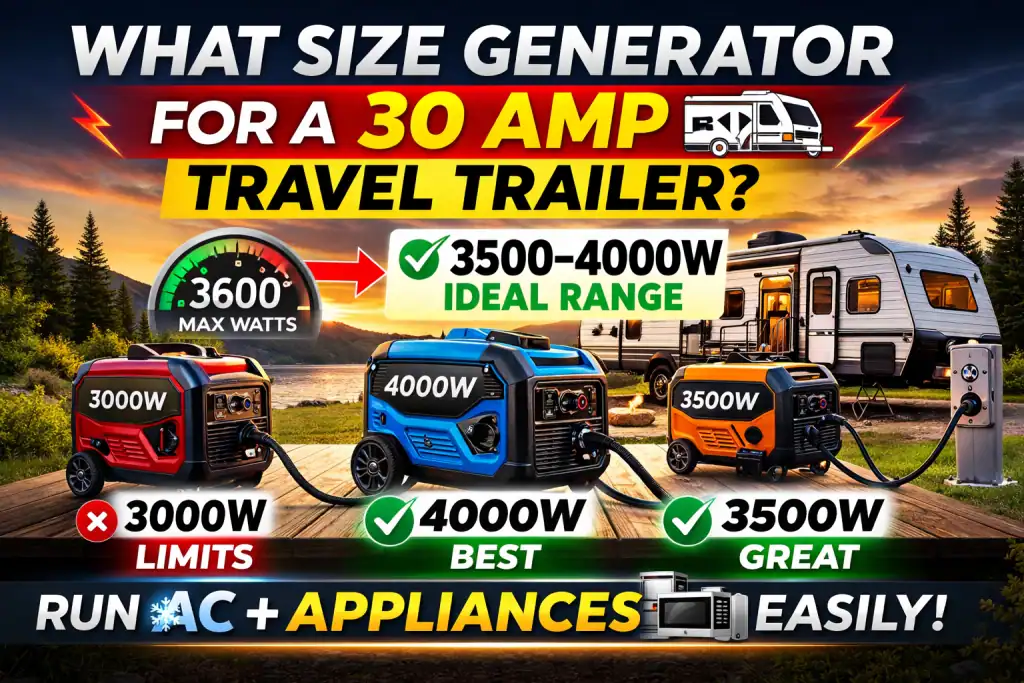
A 30 amp travel trailer can draw up to 3,600 watts of power at maximum capacity (30 amps × 120 volts). That means your generator must be capable of supplying enough running and surge watts to handle air conditioning, appliances, and startup loads without overloading.
In most cases, a generator in the 3,500 to 4,000 watt range is ideal for a 30 amp RV. Smaller 3,000 watt models may work with careful load management, but they often struggle when running a 15,000 BTU air conditioner in hot weather.
In this guide, we’ll break down how many watts a 30 amp trailer actually uses, what size generator works best, and whether you should choose 3,000, 3,500, or 4,000 watts for reliable performance.
How Many Watts Does a 30 Amp RV Use?
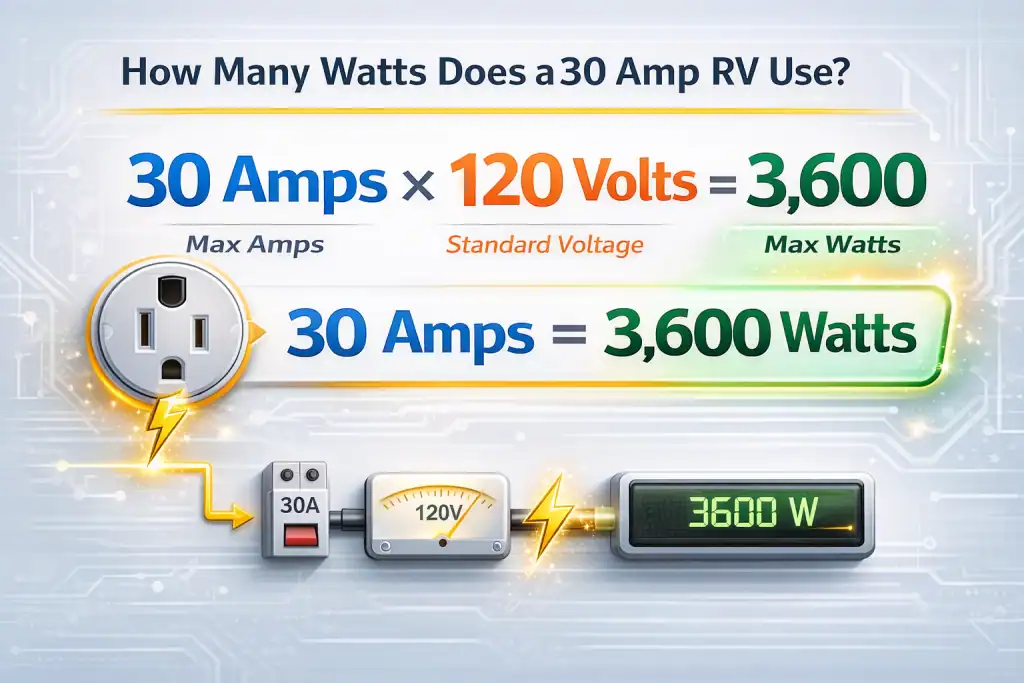
A 30 amp RV running on standard 120-volt power can draw a maximum of 3,600 watts at one time.
Here’s the formula:
30 amps × 120 volts = 3,600 watts
This 3,600 watts represents the maximum available capacity of a 30 amp electrical system. It does not mean your trailer constantly uses that much power. Most travel trailers only approach that limit when high-demand appliances like air conditioning, microwaves, or electric water heaters are operating simultaneously.
For example:
- 15,000 BTU air conditioner: 1,700–2,000 running watts
- Microwave: 900–1,200 watts
- RV refrigerator (electric mode): 500–700 watts
- Converter/battery charger: 300–500 watts
If several of these run at the same time, you can quickly approach the 3,600-watt ceiling.
Because of this, your generator should provide enough running watts to stay close to, but safely below that limit, while also offering enough surge capacity to handle startup spikes from air conditioners and compressors.
What Generator Size Is Recommended for a 30 Amp Travel Trailer?
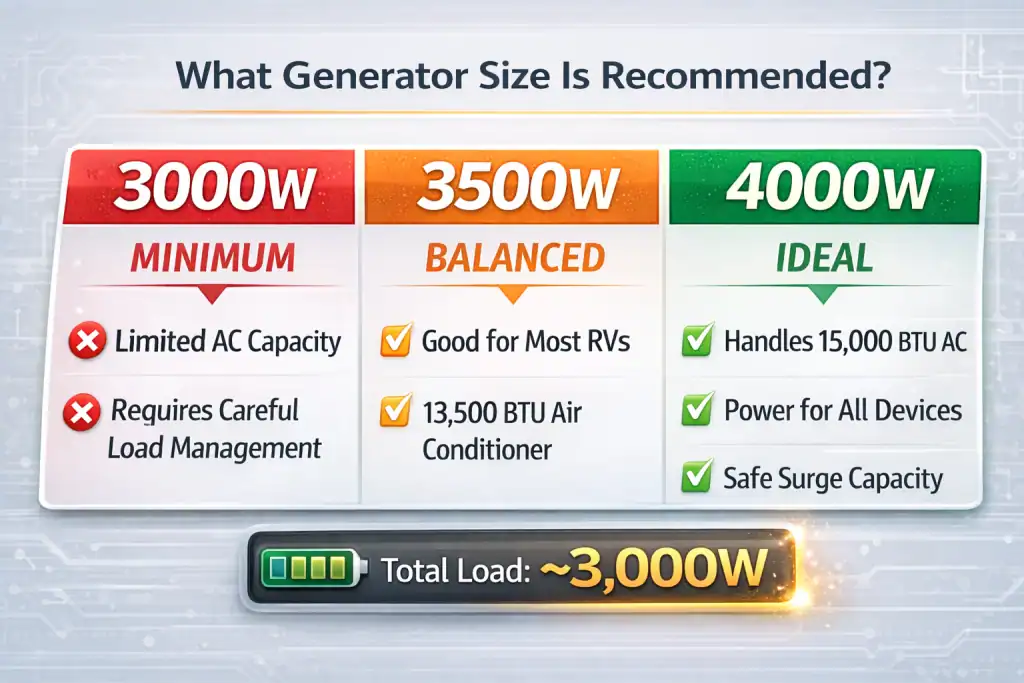
While a 30 amp travel trailer can draw up to 3,600 watts, that does not mean you need a generator rated exactly at 3,600 watts. What matters more is having enough running watts for continuous use and enough surge (starting) watts to handle appliance startup.
Here’s how generator sizes typically break down for a 30 amp RV:
🔹 3,000 Watts (Minimum Option)
A 3,000 watt inverter generator can run a 30 amp travel trailer with careful load management. It may handle a 13,500 BTU air conditioner in mild weather, but running additional appliances at the same time can push it close to overload.
This size works best if:
- You have a smaller 13,500 BTU AC
- You avoid running microwave and AC simultaneously
- You are camping in moderate temperatures
It is considered the minimum practical size for most 30 amp trailers.
🔹 3,500 Watts (Balanced Option)
A 3,500 watt generator provides better headroom and improved startup capacity. This size is often enough to run a 15,000 BTU air conditioner in average conditions while still powering basic appliances.
For many RV owners, this represents a comfortable middle ground between portability and power.
🔹 4,000 Watts (Ideal for Most Situations)
A 4,000 watt generator typically provides 3,200–3,500 running watts with strong surge capacity. This size is ideal for:
- 15,000 BTU air conditioners
- Hot-weather camping
- Higher elevations
- Running multiple appliances without constant load management
For most 30 amp travel trailers, 3,500 to 4,000 watts is the sweet spot, with 4,000 watts offering the most flexibility and reduced risk of overload.
Can a 3000 Watt Generator Run a 30 Amp RV?
Yes, a 3,000 watt generator can run a 30 amp travel trailer — but with limitations.
Most 3,000 watt inverter generators provide around 2,800–3,000 running watts and slightly higher surge capacity. While that may seem close to the 3,600-watt maximum of a 30 amp RV, you won’t be able to run everything at once.
A 3,000 watt generator can typically handle:
- A 13,500 BTU air conditioner (in moderate temperatures)
- RV refrigerator
- Converter/battery charger
- Small electronics
However, problems arise when:
- A 15,000 BTU air conditioner starts
- You run the microwave while the AC is on
- Outdoor temperatures are very high
- You are camping at higher elevation
In these scenarios, the generator may trip its overload protection.
If you’re considering this size, see our detailed breakdown of can a 3000 watt generator run a travel trailer for a full appliance-by-appliance analysis.
For occasional use and smaller trailers, 3,000 watts can work. For consistent air conditioning performance, many RV owners prefer moving up in size.
Is a 4000 Watt Generator Better for a 30 Amp Travel Trailer?
In most cases, yes — a 4,000 watt generator is a better overall match for a 30 amp travel trailer.
While a 30 amp RV is limited to 3,600 watts of maximum draw, a 4,000 watt generator provides stronger surge capacity and more consistent running wattage. Most models deliver between 3,200 and 3,500 running watts, which closely aligns with the real-world power needs of a 30 amp system.
The added capacity makes a noticeable difference when:
- Starting a 15,000 BTU air conditioner
- Running AC while using a microwave or coffee maker
- Camping in hot weather
- Operating at higher elevations where generators lose efficiency
Instead of constantly managing loads, a 4,000 watt generator provides more flexibility and reduced risk of overload trips.
If you want a full breakdown of performance, see our detailed guide on can a 4000 watt generator run a travel trailer, where we compare startup loads and appliance limits in real-world conditions.
For most RV owners with 30 amp trailers, 4,000 watts offers the best balance between portability and dependable power.
If your RV has 50 amp service instead, read our guide on what size generator for a 50 amp RV.
Example Appliance Load Scenario for a 30 Amp RV
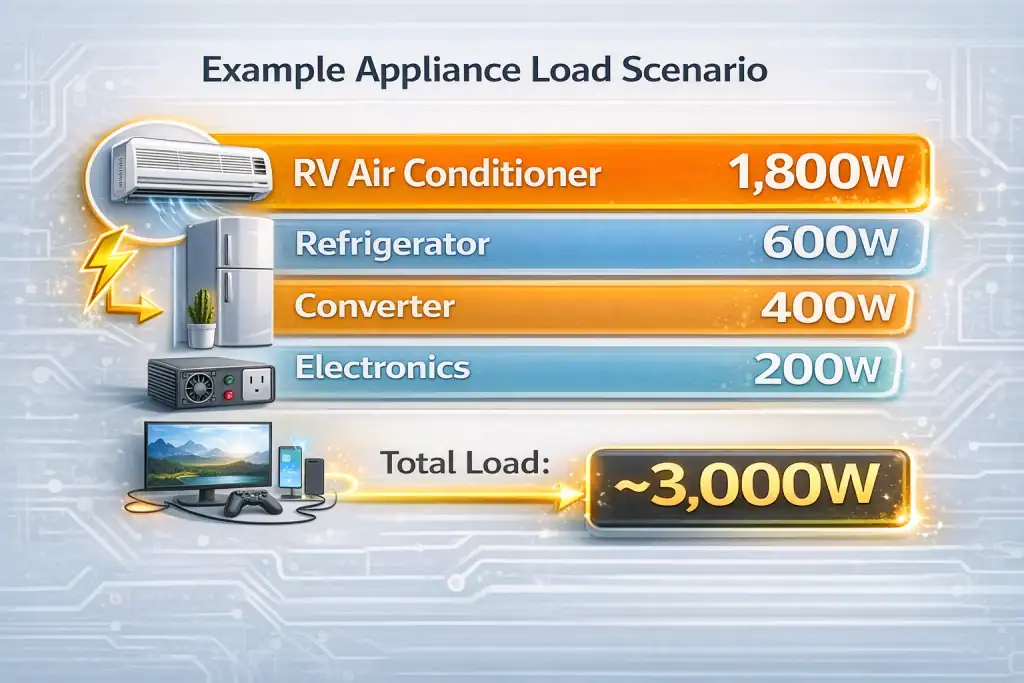
To understand why generator sizing matters, let’s look at a realistic power usage scenario inside a 30 amp travel trailer.
Imagine you’re camping on a hot afternoon and running the following:
- 15,000 BTU air conditioner: 1,800 running watts
- RV refrigerator (electric mode): 600 watts
- Converter/battery charger: 400 watts
- Television and small electronics: 200 watts
Total running load: approximately 3,000 watts
Now, if you briefly start the microwave (1,000 watts), your total jumps to around:
4,000 watts momentarily
This is where generator size becomes important. A 3,000 watt generator would likely overload in this situation. A 3,500 watt model might handle it briefly, but a 4,000 watt generator provides the surge capacity needed to manage those short spikes safely.
It’s important to remember that air conditioners also have startup surges. A 15,000 BTU unit can briefly require 3,000–3,500 watts when the compressor kicks on. If your generator is already near its limit, this surge can trip overload protection.
This is why many RV owners choose a generator slightly larger than their average running load — it provides breathing room and smoother operation.
30 Amp vs 50 Amp Generator Requirements
Understanding the difference between 30 amp and 50 amp RV systems helps clarify why generator sizing matters.
A 30 amp RV operates on:
- 120 volts
- Single hot leg
- Maximum capacity of 3,600 watts
In contrast, a 50 amp RV operates on:
- 120/240 volts
- Two separate 50 amp legs
- Up to 12,000 watts of total available power
That’s a significant difference.
While a 30 amp travel trailer can function comfortably on a 3,500–4,000 watt generator, a 50 amp RV typically requires a much larger generator — often 5,500 watts or more — especially if running multiple air conditioners.
For travel trailers specifically, you do not need to size your generator like a 50 amp fifth wheel or motorhome. Doing so would add unnecessary weight, fuel consumption, and cost.
If you own a 30 amp travel trailer, focusing on the 3,500 to 4,000 watt range is typically the most practical and efficient solution.
Recommended Generators for 30 Amp Travel Trailers
When choosing a generator for a 30 amp travel trailer, look for models that provide at least 3,500 running watts, reliable surge capacity, and an RV-ready 30 amp outlet.
Below are strong options based on performance, portability, and real-world RV use.
🔹 Best Overall for Most 30 Amp RVs (4,000W Class)
A 4,000 watt inverter generator is the most versatile option for 30 amp travel trailers. It provides enough surge capacity for a 15,000 BTU air conditioner while still powering additional appliances without constant load management.
Best for:
- Hot-weather camping
- 15,000 BTU air conditioners
- Higher elevations
- Running multiple appliances comfortably
If you want maximum flexibility and fewer overload concerns, this is the safest choice.
🔹 Best Balanced Option (3,500W Class)
A 3,500 watt generator offers a strong balance between portability and power. It can typically run a 13,500 BTU air conditioner and most essential appliances, though it may require occasional load management.
Best for:
- Moderate climates
- Smaller travel trailers
- RV owners who want lighter weight
🔹 Budget-Conscious Option (3,000W Class)
A 3,000 watt inverter generator can work for 30 amp trailers in certain situations, especially if you avoid running high-demand appliances simultaneously.
Best for:
- Occasional camping
- Smaller AC units
- Careful energy management
If you choose this size, be prepared to manage loads and avoid running microwave and AC together.
Before purchasing, always verify:
- Running watts vs surge watts
- Presence of a 30 amp RV outlet (TT-30R)
- Noise rating
- Fuel capacity and runtime
- Generator weight and portability
Choosing slightly more capacity than your average load helps prevent overload trips and improves long-term reliability.
Frequently Asked Questions
Can I plug a 30 amp travel trailer directly into a 4000 watt generator?
Yes, as long as the generator has a 30 amp RV outlet (TT-30R) or you use the proper adapter. Most 4,000 watt inverter generators designed for RV use include a 30 amp outlet. Always confirm the outlet type before purchasing.
Is 3,000 watts enough for a 30 amp camper?
A 3,000 watt generator can power a 30 amp camper with limitations. It may handle a 13,500 BTU air conditioner and basic appliances, but running multiple high-demand devices at the same time can cause overload trips. Careful load management is required.
Do I need 4,000 watts for a 15,000 BTU RV air conditioner?
In most cases, yes. A 15,000 BTU RV air conditioner can require 3,000–3,500 watts at startup. A 4,000 watt generator provides stronger surge capacity and reduces the risk of overload, especially in hot weather.
What happens if my generator is too small for my 30 amp RV?
If your generator is undersized, it may trip overload protection, struggle to start your air conditioner, or shut down when multiple appliances run simultaneously. Consistently operating near maximum capacity can also shorten generator lifespan.
Is it bad to use a generator larger than 3,600 watts on a 30 amp trailer?
No. A generator larger than 3,600 watts will not “force” extra power into your RV. Your trailer only draws the electricity it needs. Having additional capacity simply provides headroom and smoother operation.
Final Verdict: What Size Generator Do You Need for a 30 Amp Travel Trailer?
A 30 amp travel trailer can draw up to 3,600 watts, but that doesn’t mean you need a generator rated exactly at that number. What matters most is having enough running watts and surge capacity to handle air conditioner startup and simultaneous appliance use.
For most 30 amp RV owners:
- 3,000 watts is the minimum workable option with careful load management
- 3,500 watts offers a balanced middle ground
- 4,000 watts provides the most flexibility and reliable air conditioning performance
If you regularly camp in hot climates, run a 15,000 BTU air conditioner, or prefer not to constantly manage appliances, a 4,000 watt generator is typically the best overall choice.
If portability and weight are more important — and your trailer has lighter power demands — a 3,000 to 3,500 watt inverter generator may be sufficient.
Choosing the right generator size ultimately comes down to how you use your RV, your air conditioner rating, and how much power headroom you want while camping.