
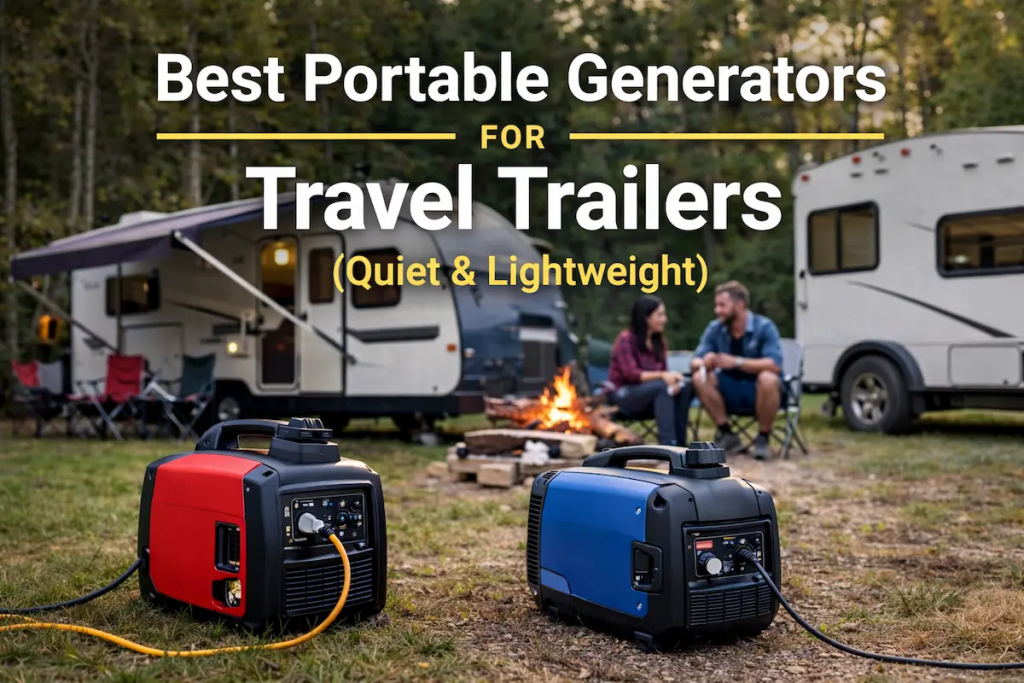
Best Portable Generators for Travel Trailers (Quiet & Lightweight)
Choosing the right portable generator for a travel trailer can be confusing, especially for first-time owners. Noise limits, power requirements, and generator weight all play an important role when selecting a unit that will work reliably at campsites or while boondocking.
This guide explains the best portable generators for travel trailers based on quiet operation, usable power output, portability, and overall reliability. It also explains how to choose the right generator size depending on your trailer’s electrical needs.
If you’re planning to camp in quiet campgrounds, you’ll want to see our guide to the quietest generator for camping.
The goal is simple: help you select a generator that runs what you need, stays campground-friendly, and avoids unnecessary problems.
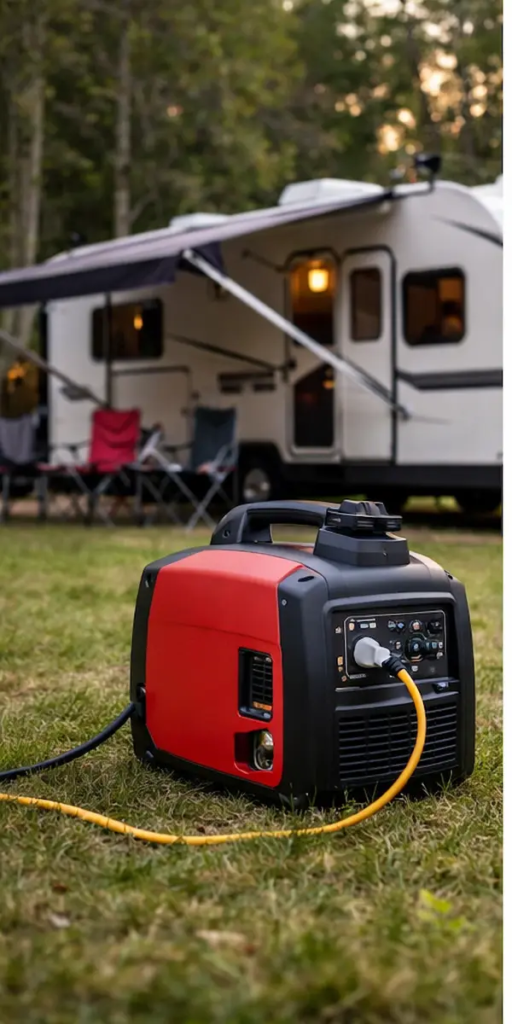
Quick Comparison: Best Portable Generators for Travel Trailers
| Generator Model | Running Watts | Starting Watts | Noise Level | Weight | Fuel Type |
|---|---|---|---|---|---|
| Honda EU2200i | 1,800 | 2,200 | 48–57 dB | 47 lbs | Gasoline |
| Yamaha EF2200iS | 1,800 | 2,200 | 57 dB | 55 lbs | Gasoline |
| Westinghouse iGen2200 | 1,800 | 2,200 | 52 dB | 46 lbs | Gasoline |
| Champion 4500 Dual Fuel Inverter | 3,500 | 4,500 | 61 dB | 95 lbs | Gas/Propane |
| WEN 56225i | 1,800 | 2,250 | 53 dB | 48 lbs | Gasoline |
| Generac GP3500iO | 3,000 | 3,500 | 59 dB | 74 lbs | Gasoline |
How to Choose the Right Generator for a Travel Trailer
When selecting a generator for your travel trailer, several factors should be considered.
Power requirements
- Small trailers may only need 1500–2000 watts for lights, battery charging, and electronics
- Running a roof air conditioner often requires 3000–4500 watts
Noise restrictions
- Many campgrounds enforce generator noise limits
- Inverter generators are typically much quieter than traditional open-frame generators
Weight and portability
- Generators under 50 pounds are easier to move and store
- Larger generators may include wheels but are harder to lift into a truck or storage compartment
Inverter vs conventional generators
- Inverter generators produce cleaner power for electronics
- They are usually quieter and more fuel efficient
Parallel capability
- Some generators allow two units to be connected together
- This provides additional power while maintaining portability
If you have a larger RV, see our guide explaining what size generator for a 50 amp RV.
Best Portable Generators for Travel Trailers
1. Honda EU2200i
Best for quiet operation
The Honda EU2200i is widely considered one of the most reliable portable inverter generators available. Its quiet operation and consistent power output make it a common choice for RV and travel trailer owners.
Pros
- Extremely quiet operation
- Reliable engine performance
- Lightweight and easy to transport
- Parallel capability available
Cons
- Higher price than many competitors
- Limited power for larger trailers with air conditioning
2. Yamaha EF2200iS
Reliable inverter generator for small trailers
The Yamaha EF2200iS offers similar power to the Honda EU2200i but includes slightly higher starting capacity. It is commonly used for small trailers or light electrical loads.
Pros
- Strong starting performance
- Good fuel efficiency
- Quiet inverter design
Cons
- Slightly heavier than similar generators
- More expensive than budget options
3. Westinghouse iGen2200
Best budget-friendly inverter generator
The Westinghouse iGen2200 provides similar wattage to premium models at a lower price point. It is suitable for powering basic travel trailer needs such as battery charging and small appliances.
Pros
- Affordable inverter generator
- Lightweight design
- Parallel capable
Cons
- Slightly louder than premium models
- Build quality not as strong as Honda or Yamaha
4. Champion 4500 Dual Fuel Inverter
Best for running RV air conditioners
The Champion 4500 Dual Fuel inverter generator provides significantly more power than smaller portable generators. This allows it to start and run many travel trailer air conditioners.
Pros
- Higher wattage capacity
- Dual fuel capability (gasoline or propane)
- Electric start
Cons
- Much heavier than smaller generators
- More difficult to transport
5. WEN 56225i
Compact generator for basic trailer power
The WEN 56225i is another small inverter generator designed for light loads. It is often used for charging batteries, running lights, and powering small electronics.
Pros
- Lightweight design
- Affordable price
- Parallel capable
Cons
- Limited wattage capacity
- May struggle with larger appliances
6. Generac GP3500iO
Mid-size inverter generator option
The Generac GP3500iO provides more power than smaller inverter generators while still maintaining relatively quiet operation.
Pros
- Higher running wattage
- Inverter power for sensitive electronics
- Electric start
Cons
- Heavier than small portable generators
- Not as quiet as smaller inverter models
Generator Noise Levels Explained
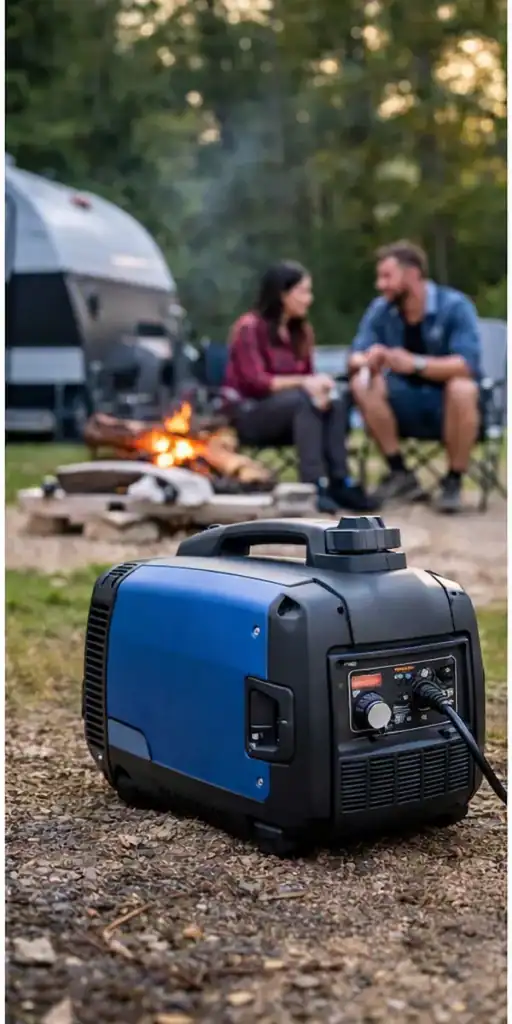
Generator noise levels are typically measured in decibels (dB). Most inverter generators operate between 48 and 60 dB, which is similar to normal conversation.
Inverter generators are ideal if you need a quiet generator for camping without disturbing others.
Several factors influence generator noise.
Inverter generators
- Designed with enclosed housings
- Variable engine speed reduces noise
Open-frame generators
- Often produce 65–75 dB or more
- Typically louder and less campground-friendly
Many campgrounds restrict generator noise or limit generator hours, making quieter inverter generators a better option for travel trailer owners.
How Big of a Generator Do You Need for a Travel Trailer?
Generator size depends primarily on the appliances you plan to run.
Typical travel trailer power requirements include:
Basic trailer use
- Battery charging
- Lights
- Refrigerator controls
- Small electronics
These loads usually require 1500–2000 watts.
Running a roof air conditioner
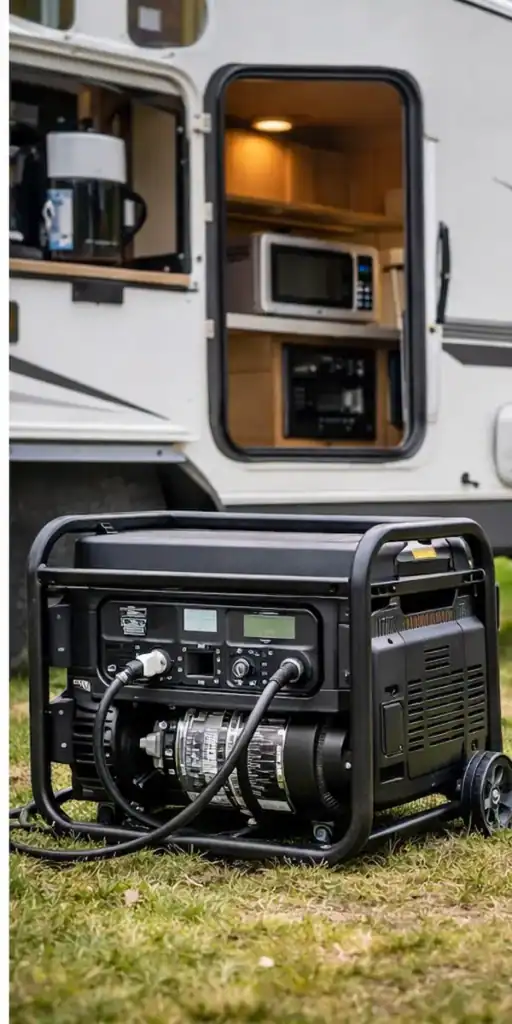
Most travel trailers use 13,500 BTU or 15,000 BTU air conditioners. These units often require 3000–4500 starting watts.
Because of startup surge, many RV owners either:
- Use a larger generator (3500–4500 watts)
- Run two smaller generators in parallel
Soft start devices can also reduce the starting wattage required for an air conditioner.
If you’re trying to run an RV air conditioner, you may want to read our full guide on Can a 13,500 BTU RV Air Conditioner Run on a Generator.
If you are unsure what size generator you need, start with our Generator Sizing Guide for Travel Trailers.
Frequently Asked Questions
Can a portable generator run a travel trailer air conditioner?
Yes, but it depends on generator size. Many air conditioners require 3000 watts or more to start.
How quiet does a generator need to be for campgrounds?
Many campgrounds prefer generators under 60 dB, which is typical for inverter generators.
Can a generator damage a travel trailer?
Poor-quality generators can produce unstable power. Inverter generators provide cleaner electricity that is safer for electronics.
Is dual fuel worth it for RV generators?
Dual fuel generators allow the use of propane or gasoline, which provides flexibility when camping or traveling.
Conclusion
Choosing the right generator for a travel trailer depends on your power needs, noise limits, and portability requirements. For many RV owners, a quiet inverter generator provides the best balance of reliability, efficiency, and campground compatibility.
If you’re considering a smaller generator, you may want to read Can a 2000 Watt Generator Run a Travel Trailer?
If you have a larger RV, see our guide explaining what size generator for a 50 amp RV.