Best Solar Panels for Camping (2026 Guide)
Whether you’re tent camping for the weekend, traveling in an RV, or spending days off-grid, portable solar panels make it easier than ever to keep your essential devices powered. From charging phones and laptops to running portable refrigerators and power stations, the right solar panel can provide quiet, renewable energy wherever your adventures take you.
In this guide, you’ll learn how to choose the best solar panels for camping, compare the top portable models, understand how much solar power you need, and find the right setup for your next adventure.
What Are the Best Solar Panels for Camping?
The best solar panels for camping are portable, foldable panels between 100W and 200W that can reliably charge devices and portable power stations. Top options include the Jackery SolarSaga 100W, EcoFlow 110W, and Renogy 100W depending on your budget and power needs.
- 50W–100W → phones and small devices
- 100W–200W → camping fridges and power stations
- 200W+ → full off-grid setups
Disclosure
We independently research and recommend products we believe provide the best value for campers and RV owners. This article contains affiliate links, and we may earn a commission if you make a purchase through our links—at no additional cost to you. Learn more in our Affiliate Disclosure.
Quick Picks (Top Solar Panels for Camping)
If you just want the best options right now:
- Best Overall: Jackery SolarSaga 100W Portable Solar Panel
- Best Budget: Renogy 100 Watt 12 Volt Monocrystalline Solar Panel
- Best Folding Panel: EcoFlow 110W Portable Solar Panel
- Best for Power Stations: Bluetti PV120 Solar Panel
- Best Lightweight: Goal Zero Nomad 50 Solar Panel
| Solar Panel | Wattage | Weight | Best For |
|---|---|---|---|
| Jackery SolarSaga 100W | 100W | 10.3 lbs | Best Overall |
| EcoFlow 110W | 110W | 13 lbs | Fast Charging |
| Renogy 100W | 100W | 14 lbs | Budget Setup |
| Bluetti PV120 | 120W | 12.5 lbs | Power Stations |
| Goal Zero Nomad 50 | 50W | 6.8 lbs | Lightweight Travel |
Why Solar Panels Are Perfect for Camping
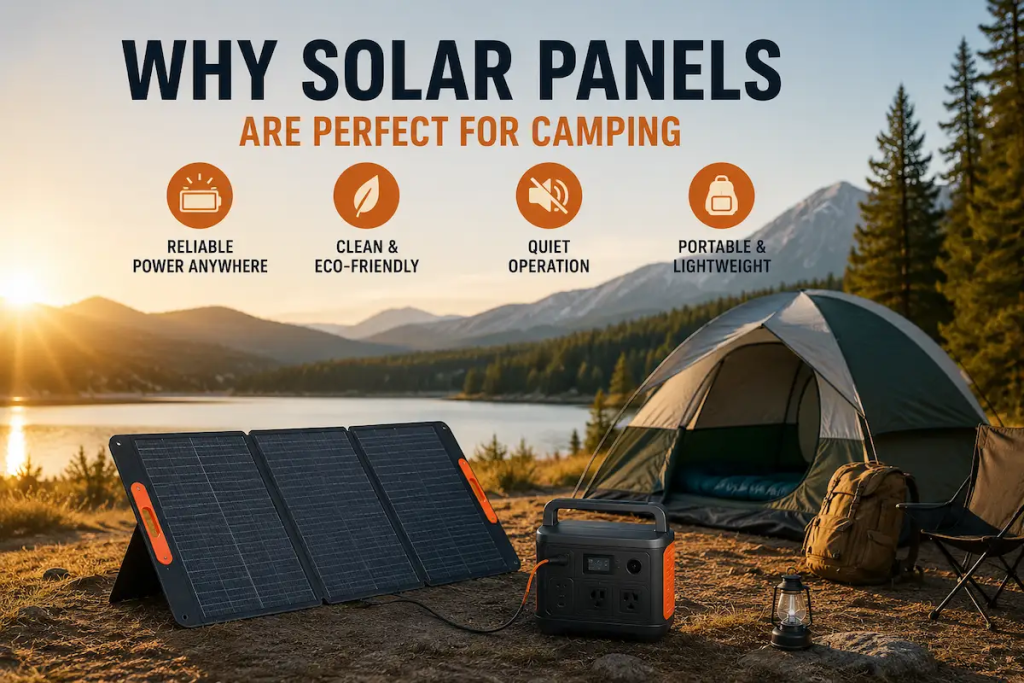
Solar panels are one of the most practical upgrades you can bring on a camping trip.
They allow you to:
- Charge devices without a generator
- Stay off-grid longer
- Power essentials like lights, fans, and fridges
- Pair with portable power stations for silent energy
If you’re already using a portable power station or considering a solar generator, solar panels are the perfect complement because they allow you to recharge your battery bank during the day without relying on shore power.
Types of Solar Panels for Camping
Understanding the types will help you avoid buying the wrong setup.
| Type | Best For | Portable | Efficiency |
|---|---|---|---|
| Foldable | Camping | ✅ | High |
| Rigid | RV Roofs | ❌ | Highest |
| Flexible | Curved Surfaces | ✅ | Moderate |
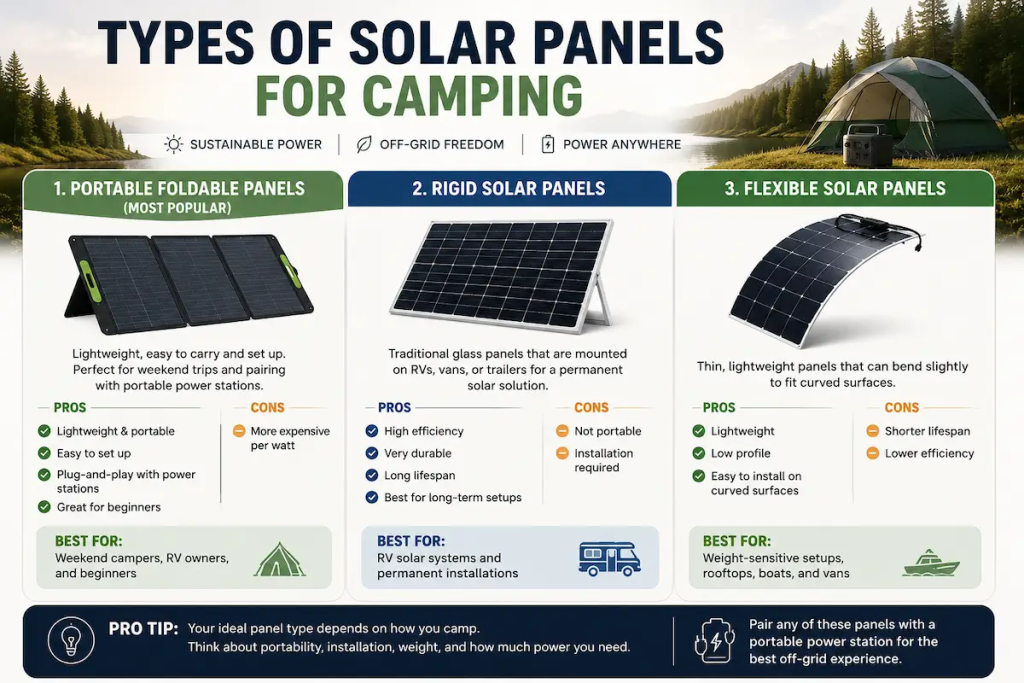
1. Portable Foldable Panels (Most Popular)
These are the go-to for most campers.
Pros:
- Lightweight
- Easy to carry
- Quick setup
- Plug-and-play with power stations
Cons:
- More expensive per watt
👉 Best for: Weekend campers, RV owners, beginners
2. Rigid Solar Panels
These are traditional panels mounted on RVs or trailers.
Pros:
- High efficiency
- Durable
- Best long-term solution
Cons:
- Not portable
- Installation required
👉 Best for: RV solar systems
3. Flexible Solar Panels
Thin panels that can bend slightly.
Pros:
- Lightweight
- Low profile
Cons:
- Shorter lifespan
- Lower efficiency
👉 Best for: Weight-sensitive setups
How We Chose These Solar Panels
We evaluated each solar panel based on portability, efficiency, durability, weight, compatibility with portable power stations, customer reviews, and overall value. Our goal was to recommend panels that perform well for campers, RV owners, and anyone looking for reliable off-grid power.
Best Solar Panels for Camping (Full Breakdown)
Below are our top picks for the best solar panels for camping. Each recommendation was selected based on real-world usability, durability, efficiency, portability, and overall value.
1. Jackery SolarSaga 100W – Best Overall

Best For: Weekend campers and beginners
Wattage: 100W
Weight: 10.3 lbs
Foldable: Yes
Warranty: Warranty: 2-year limited warranty
Pros
- Easy to carry
- Reliable performance
- Great with portable power stations
Cons
- Premium price
View current pricing, availability, and customer reviews on Amazon.
2. Renogy 100W – Best Budget Option

Best For: Budget-conscious campers and DIY solar setups
Wattage: 100W
Weight: 14 lbs
Foldable: No
Warranty: 25-year power output warranty / 5-year material warranty
Pros
- Affordable price
- Durable aluminum frame
- High-efficiency monocrystalline cells
- Great for RV roof installations or custom solar systems
Cons
- Not portable
- Requires mounting hardware for permanent installations
View current pricing, availability, and customer reviews on Amazon.
3. EcoFlow 110W – Best Folding Panel

Best For: Fast charging with EcoFlow power stations
Wattage: 110W
Weight: 13 lbs
Foldable: Yes
Warranty: 12 months (or whatever is current)
Pros
- High solar conversion efficiency
- Foldable, lightweight design
- Built-in adjustable kickstand
- Water-resistant construction
Cons
- Higher price than similar 100W panels
- Performs best when paired with EcoFlow products
View current pricing, availability, and customer reviews on Amazon.
4. Bluetti PV120 – Best for Power Stations

Best For: Bluetti power stations and versatile off-grid charging
Wattage: 120W
Weight: 12.5 lbs
Foldable: Yes
Warranty: Current manufacturer’s warranty
Pros
- Excellent compatibility with Bluetti power stations
- Foldable and easy to transport
- Durable ETFE laminated surface
- Good charging performance in full sunlight
Cons
- Premium price
- Larger folded size than some competing panels
View current pricing, availability, and customer reviews on Amazon.
5. Goal Zero Nomad 50 – Best Lightweight Option

Best For: Backpacking, overlanding, and lightweight camping
Wattage: 50W
Weight: 6.8 lbs
Foldable: Yes
Warranty: Current manufacturer’s warranty
Pros
- Extremely lightweight
- Compact folding design
- Easy to pack and transport
- Excellent for charging smaller devices and portable power stations
Cons
- Lower power output than 100W+ panels
- Not ideal for running larger appliances
View current pricing, availability, and customer reviews on Amazon.
| Product | Best For | Wattage | Weight |
|---|---|---|---|
| Jackery SolarSaga 100W | Overall | 100W | 10.3 lbs |
| Renogy 100W | Budget | 100W | 14 lbs |
| EcoFlow 110W | Fast Charging | 110W | 13 lbs |
| Bluetti PV120 | Power Stations | 120W | 12.5 lbs |
| Goal Zero Nomad 50 | Lightweight | 50W | 6.8 lbs |
What Size Solar Panel Do You Need?
This is where most people get it wrong.
Basic Wattage Guide:
- Phone charging → 20W–50W
- Laptop → 60W–100W
- Portable fridge → 100W–200W
- Full campsite setup → 200W+
👉 Rule of thumb:
Always go bigger than you think—you’ll lose power from clouds, angle, and inefficiencies.
If you’re unsure how much power your appliances require, our RV generator sizing guide can help you calculate your total wattage needs before purchasing a solar panel setup.
Pro Tip: If you’re planning to power a portable refrigerator or CPAP machine, consider a 200W solar panel paired with a portable power station. This provides faster charging and more reliable performance during cloudy weather.
How Long Does It Take a Solar Panel to Charge a Power Station?
Charging time depends on four main factors: the size of your solar panel, the capacity of your portable power station, available sunlight, and weather conditions. The estimates below assume ideal sunlight and a 500Wh portable power station.
100W panel → 8–12 hours (500Wh power station)
200W panel → 4–6 hours
400W panel → 2–4 hours
Real-world charging times are often longer because of cloud cover, high temperatures, shading, and the angle of the solar panel. Repositioning your panel throughout the day can significantly improve charging performance.
Best Solar Generators for Camping
How to Set Up Solar Panels While Camping
Step-by-Step Setup:
- Place panels in direct sunlight
- Angle them toward the sun
- Connect to your power station or battery
- Avoid shade (even partial shade hurts output)
- Adjust throughout the day for max efficiency
Many campers pair solar panels with a portable power station to store energy for nighttime use and cloudy days.
Solar Panel + Generator Setup (Best Combo)
The most powerful setup is:
Solar Panel + Portable Power Station
A solar panel paired with a solar generator creates one of the most flexible off-grid power systems available for camping, RV travel, and boondocking.
- Silent power
- Energy storage
- Recharge during the day
For a complete off-grid power solution, pair your solar panel with a portable power station. If you’re still comparing options, check out our guide to the best solar generators for camping to find a setup that matches your power needs.
Common Mistakes to Avoid
- Buying too small of a panel
- Not checking compatibility
- Ignoring sunlight conditions
- Expecting full rated output (you’ll usually get ~60–80%)
Choosing a panel that is too small is one of the most common mistakes campers make. Understanding your daily energy consumption can prevent overspending and underpowered setups.
Spending a few extra minutes sizing your system correctly can save money, improve reliability, and ensure you have enough power throughout your camping trip.
FAQ: Solar Panels for Camping
How many watts of solar do I need for camping?
Most campers need between 100W and 200W of solar power. Smaller setups are suitable for charging phones and tablets, while larger setups can support portable refrigerators, power stations, and other camping essentials.
Can I leave my solar panel outside in the rain?
Most portable camping solar panels are weather-resistant, but not all are fully waterproof. Always check the manufacturer’s IP rating before leaving a panel exposed to heavy rain or snow.
Are solar panels worth it for camping?
Yes—especially for longer trips or off-grid setups.
Can solar panels run a camping fridge?
Yes, but you’ll need at least 100W–200W plus a battery.
Do solar panels work on cloudy days?
Yes, but output drops significantly.
Do I need a battery?
If you want power at night—yes.
Recommended Camping Solar Setup
For most campers, a 100W–200W foldable solar panel paired with a solar generator offers the best combination of portability, battery storage, and off-grid capability.
If you’re still comparing options, check out our guide to the best solar generators for camping to find a compatible power station for your solar setup.
Bottom Line
For most campers, a 100W–200W foldable solar panel paired with a portable power station offers the best combination of portability, charging speed, and off-grid capability.
Weekend campers will usually be satisfied with a 100W panel, while longer trips and larger power demands often justify stepping up to a 200W model.
Final Thoughts
The best solar panels for camping depend on how you camp:
- Casual trips → portable folding panels
- RV setups → rigid panels
- Lightweight travel → compact panels
If you want the easiest solution, go with a foldable panel + power station combo—it’s the fastest way to get reliable off-grid power.
Affiliate Disclaimer
This article contains affiliate links. If you purchase through these links, we may earn a commission at no extra cost to you.