
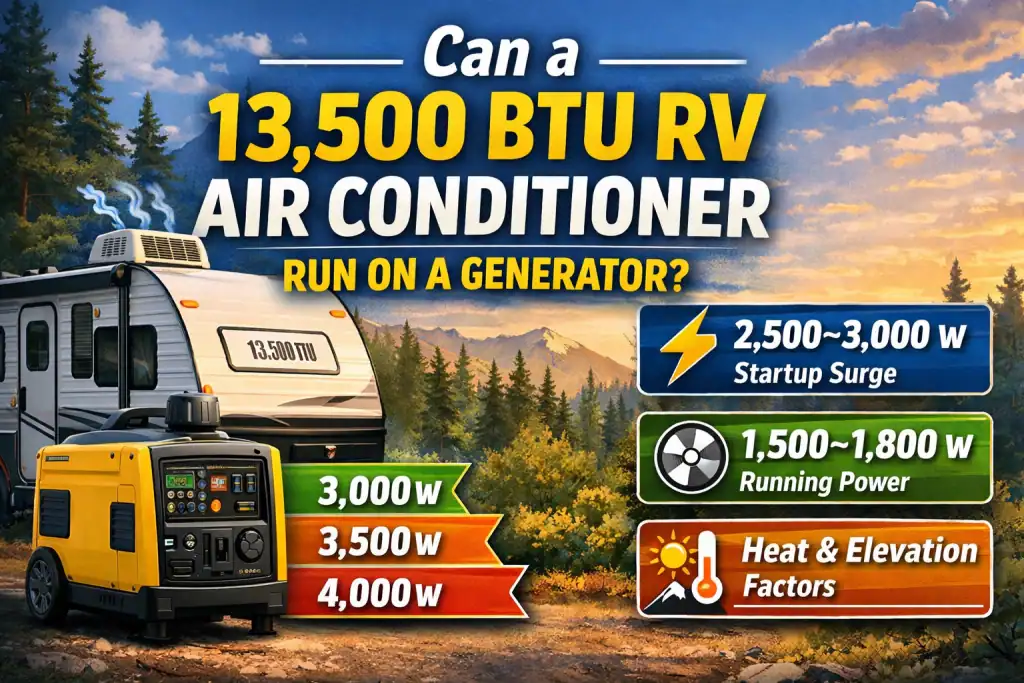
Yes — in most cases, a properly sized portable generator can run a 13,500 BTU RV air conditioner
A properly sized portable generator. However, success depends on both the running wattage and the startup surge capacity of the generator.
A typical 13,500 BTU RV air conditioner draws around 1,500 to 1,800 running watts, with startup surge often reaching 2,500 to 3,000 watts when the compressor kicks on. If your generator cannot handle that brief surge, it may trip overload protection or fail to start the unit.
If you’re unsure how generator size relates to RV power limits overall, see our guide on what size generator for a 30 amp travel trailer.
In this guide, we’ll break down exactly how many watts a 13,500 BTU RV AC uses, what generator sizes work best, and whether 3,000, 3,500, or 4,000 watts is the ideal choice.
How Many Watts Does a 13,500 BTU RV Air Conditioner Use?
A typical 13,500 BTU RV air conditioner uses:
- 1,500 to 1,800 running watts
- 2,500 to 3,000 starting (surge) watts
The running watts represent the continuous power needed once the compressor is already operating.
The starting watts represent the brief spike of electricity required when the compressor first turns on. This surge usually lasts only a second or two but is the most demanding moment for your generator.
Here’s a simple breakdown of where that power goes:
- Fan motor: 300–500 watts
- Compressor (running): 1,200–1,400 watts
- Total running load: ~1,500–1,800 watts
- Compressor startup surge: up to 3,000 watts
Because startup surge is significantly higher than running load, generator sizing must account for that brief spike — not just the continuous wattage rating.
Startup vs Running Watts Explained for 13,500 BTU Units
When powering a 13,500 BTU RV air conditioner with a generator, the most important number is often the startup surge, not the running wattage.
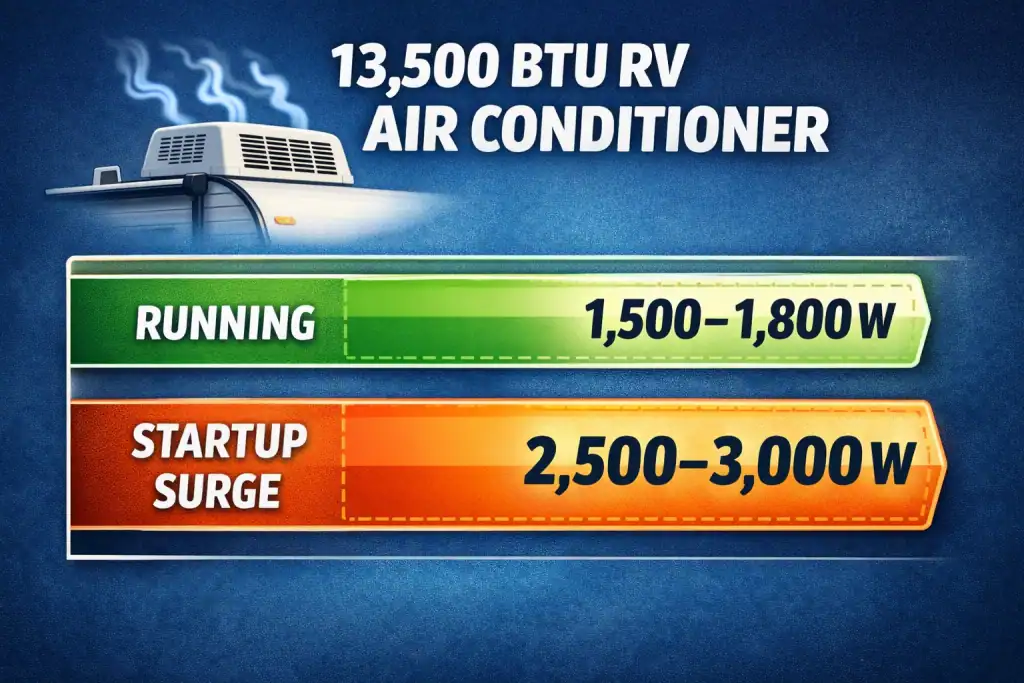
Running watts (1,500–1,800 watts) represent the steady power required to keep the air conditioner operating once the compressor is already on.
Startup watts (2,500–3,000 watts) are the short burst of extra power required when the compressor first kicks on. This surge only lasts a second or two, but it can cause smaller generators to trip overload protection.
For example:
- A generator rated at 2,000 running watts may keep the AC operating once started
- But if it only provides 2,200 surge watts, it may fail during startup
That’s why matching only the running watt number is not enough.
Most inverter generators list both:
- Continuous (running) watts
- Peak or surge watts
When selecting a generator for a 13,500 BTU RV air conditioner, the surge rating must safely exceed the compressor’s startup requirement.
Because the startup surge for a 13,500 BTU unit is lower than that of a 15,000 BTU unit, more generator options become viable — including many 3,000 watt inverter models.
What Size Generator Is Required for a 13,500 BTU RV AC?
In most cases, a generator in the 3,000 to 3,500 watt range is sufficient to run a 13,500 BTU RV air conditioner reliably.
Here’s why:
- Running load: 1,500–1,800 watts
- Startup surge: 2,500–3,000 watts
- Additional RV appliances: 300–1,000+ watts
Even though the air conditioner alone uses less than 2,000 running watts, your RV will likely be powering other systems at the same time, such as:
- Refrigerator
- Converter/battery charger
- Interior lights
- Television or small electronics
Because of this combined demand, the generator must handle both the startup surge and the background load.
Recommended Generator Size by Scenario
- 2,000 watts: Usually too small unless paired in parallel or used with a soft start
- 3,000 watts: Often sufficient for most 13,500 BTU units
- 3,500 watts: Provides additional headroom and improved reliability
- 4,000 watts: Offers the most flexibility and reduced overload risk
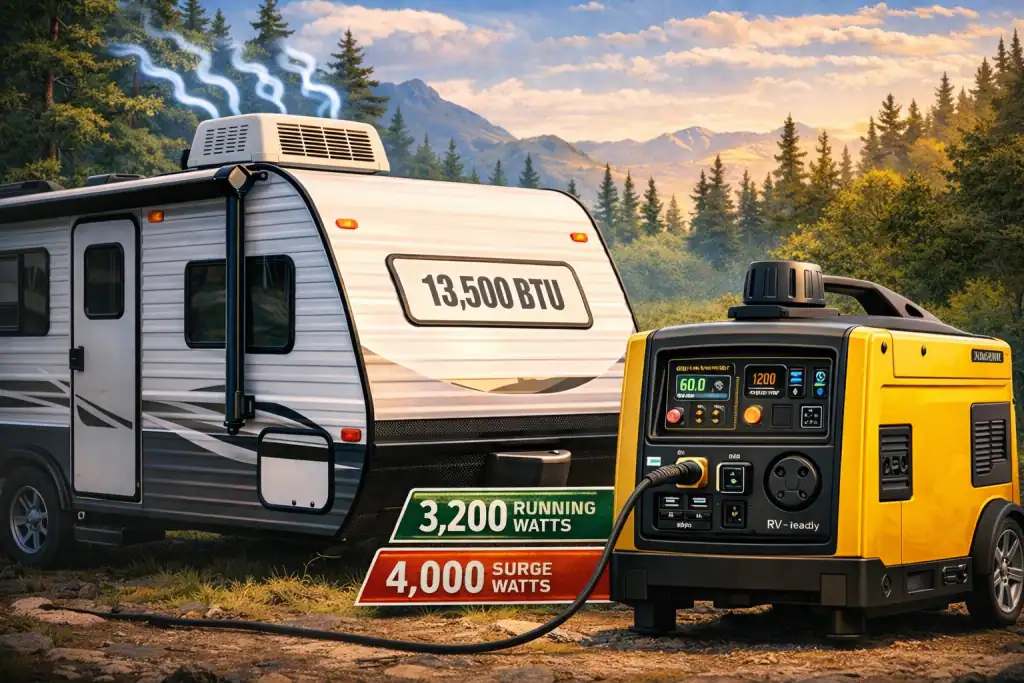
For many travel trailers equipped with a 13,500 BTU air conditioner, a 3,000 or 3,500 watt inverter generator provides the best balance between power and portability.
Can a 3000 Watt Generator Run a 13,500 BTU RV Air Conditioner?
Yes — in most cases, a 3,000 watt inverter generator can run a 13,500 BTU RV air conditioner.
For a full breakdown of appliance limits and load management, see can a 3000 watt generator run a travel trailer.
Most 3,000 watt inverter generators provide:
- 2,800–3,000 running watts
- Slightly higher surge capacity
Because a 13,500 BTU unit typically requires 2,500–3,000 watts at startup and 1,500–1,800 watts while running, many 3,000 watt generators can handle this load — especially in moderate temperatures.
However, success depends on:
- Outdoor temperature
- Elevation
- Other appliances running simultaneously
- The specific AC model
If the refrigerator, converter, or microwave are drawing power at the same time the compressor starts, overload trips can occur.
For a detailed breakdown of how 3,000 watt generators perform in real-world travel trailer setups, see our guide on can a 3000 watt generator run a travel trailer.
For many RV owners, 3,000 watts is the minimum practical size for reliably running a 13,500 BTU air conditioner.
Can a 3500 Watt Generator Run a 13,500 BTU RV Air Conditioner?
Yes — a 3,500 watt generator can reliably run a 13,500 BTU RV air conditioner in most conditions.
Most 3,500 watt inverter generators provide:
- 3,000–3,200 running watts
- Up to 3,500 surge watts
Since a 13,500 BTU unit typically requires no more than 3,000 watts at startup and under 1,800 watts while running, a 3,500 watt generator provides a comfortable power margin.
Compared to a 3,000 watt unit, 3,500 watts offers:
- More stable compressor startup
- Greater flexibility for running additional appliances
- Reduced overload risk in hot weather
- Better performance at moderate elevations
For many travel trailer owners, 3,500 watts represents a strong balance between portability and reliable air conditioning performance.
If you’re comparing overall generator sizing, see our full breakdown on can a 3500 watt generator run a travel trailer for detailed real-world scenarios.
Can a 4000 Watt Generator Run a 13,500 BTU RV Air Conditioner?
Yes — a 4,000 watt generator can easily run a 13,500 BTU RV air conditioner in most situations.
Most 4,000 watt inverter generators provide:
- 3,200–3,500 running watts
- Up to 4,000 surge watts
Since a 13,500 BTU RV air conditioner typically requires no more than 3,000 watts at startup and under 1,800 watts while running, a 4,000 watt generator provides substantial headroom.
This extra capacity allows you to:
- Run additional appliances more comfortably
- Reduce overload trips
- Improve reliability in hot weather
- Offset power loss at elevation
While 4,000 watts may be more than strictly necessary for a 13,500 BTU unit, many RV owners prefer the added flexibility and reduced strain.
If you’re evaluating overall travel trailer capability, review our guide on can a 4000 watt generator run a travel trailer for a broader power comparison.
Does a Soft Start Help with a 13,500 BTU RV AC?
Yes — a soft start device can reduce the startup surge of a 13,500 BTU RV air conditioner and make it easier for smaller generators to handle compressor startup.
A standard 13,500 BTU unit may require up to 3,000 watts during startup. A soft start gradually ramps up compressor power instead of allowing a sudden spike, often reducing startup demand by 20% to 40%.
With a soft start installed:
• Startup surge may drop closer to 2,000–2,400 watts
• A 3,000 watt generator operates more comfortably
• Overload trips become less likely
• Generator strain is reduced
For RV owners using a 3,000 watt inverter generator, a soft start can significantly improve reliability — especially in hot weather.
Even with a 3,500 or 4,000 watt generator, a soft start reduces mechanical stress on the compressor and improves overall system stability.
While not required for most 13,500 BTU setups, a soft start can add an extra layer of reliability and flexibility.
Recommended Generator Sizes for a 13,500 BTU RV Air Conditioner
When selecting a generator specifically to power a 13,500 BTU RV air conditioner, surge capacity and total available running watts are the most important factors.
Below are the generator size categories that work best in most travel trailer setups.
Minimum Practical Size: 3,000 Watts
A 3,000 watt inverter generator can run a 13,500 BTU RV air conditioner in many conditions, especially if:
- Outdoor temperatures are moderate
- Other appliances are limited
- A soft start is installed
This size offers good portability while remaining capable of handling startup surge in most cases.
Balanced Choice: 3,500 Watts
A 3,500 watt generator provides a more comfortable power margin.
Best for:
- Running AC plus refrigerator and converter
- Reduced overload risk
- Moderate heat and elevation
For many mid-size travel trailers, this size represents the best balance between performance and portability.
Maximum Flexibility: 4,000 Watts
A 4,000 watt generator provides the greatest reliability and headroom.
Best for:
- Running additional appliances alongside AC
- High temperatures
- Higher elevations
- RV owners who prefer extra power margin
While 4,000 watts may be more than strictly necessary for a 13,500 BTU unit, the added capacity reduces overload risk and improves long-term stability.
Which Size Is Right for You?
For most RV owners running a 13,500 BTU air conditioner, 3,000 to 3,500 watts is sufficient. If you prefer additional flexibility or frequently camp in demanding conditions, stepping up to 4,000 watts provides extra insurance against overload.
If you’re also comparing larger air conditioner sizes, see our breakdown of can a generator run a 15,000 BTU RV air conditioner for higher-demand setups.
If you’re considering a larger air conditioner, see can a generator run a 15,000 BTU RV air conditioner for higher startup demand comparisons.
Frequently Asked Questions
How many watts does a 13,500 BTU RV air conditioner need to start?
A 13,500 BTU RV air conditioner typically requires between 2,500 and 3,000 watts during startup. This surge only lasts a few seconds but must be supported by the generator’s peak capacity.
Can a 2,000 watt generator run a 13,500 BTU RV air conditioner?
In most cases, no. A single 2,000 watt generator usually does not provide enough surge capacity to start the compressor. Some RV owners run two 2,000 watt generators in parallel to meet startup demand.
Is 3,000 watts enough for a 13,500 BTU RV AC?
Yes, in many situations. A 3,000 watt inverter generator can typically run a 13,500 BTU air conditioner, especially in moderate temperatures and with limited additional appliance use.
Does elevation affect generator performance?
Yes. Generators generally lose about 3% to 3.5% of power for every 1,000 feet of elevation. At higher elevations, startup performance may decrease.
Do I need a soft start for a 13,500 BTU RV air conditioner?
A soft start is not required in most cases, but it reduces startup surge and improves compatibility with smaller generators, particularly 3,000 watt models.
Final Verdict: Can a 13,500 BTU RV Air Conditioner Run on a Generator?
Yes — in most cases, a 13,500 BTU RV air conditioner can run on a properly sized portable generator.
Because startup surge typically reaches 2,500–3,000 watts and running load remains under 1,800 watts, many 3,000 watt inverter generators are capable of handling this air conditioner size.
For most RV owners:
- 3,000 watts is the practical minimum
- 3,500 watts provides additional reliability and headroom
- 4,000 watts offers maximum flexibility and reduced overload risk
If you frequently camp in hot weather, operate at elevation, or prefer running additional appliances alongside air conditioning, choosing slightly more generator capacity improves stability and performance.
When properly sized, a portable generator can run a 13,500 BTU RV air conditioner reliably and keep your travel trailer comfortable in a wide range of camping conditions.