
Yes — in many cases, a 3,500 watt generator can run a travel trailer, including models equipped with air conditioning. However, performance depends on your air conditioner size, appliance usage, and how much power headroom you want while camping.
Most 3,500 watt generators provide around 3,000–3,200 running watts, with surge capacity reaching close to 3,500 watts. That places them between smaller 3,000 watt units and more powerful 4,000 watt models in terms of overall capability.
In this guide, we’ll break down what a 3,500 watt generator can realistically power, whether it can handle 13,500 or 15,000 BTU RV air conditioners, and how it compares to 3,000 and 4,000 watt options.
What Does a 3500 Watt Generator Actually Provide?
A 3,500 watt generator is considered a mid-range portable power option for RV owners. While the advertised rating is 3,500 watts, the most important number to look at is the running (continuous) wattage, which typically falls between 3,000 and 3,200 watts on most inverter models.
That continuous output is what determines how many appliances your travel trailer can operate at the same time.
In practical RV use, a 3,500 watt generator generally provides:
- Reliable power for a 13,500 BTU RV air conditioner
- Enough capacity for basic appliances such as a refrigerator and converter
- Limited headroom for high-demand appliances like a microwave
- Moderate surge capacity for compressor startup
If you’re unsure how that limit affects generator sizing, see our guide on what size generator for a 30 amp travel trailer. a 3,500 watt generator operates close to that ceiling — but not quite at it. This makes load management important, especially when running air conditioning.
Compared to smaller 3,000 watt generators, a 3,500 watt model provides noticeable improvement in startup capability and stability. However, it does not offer the same power margin as a 4,000 watt unit.
For many RV owners, 3,500 watts represents a balanced middle ground between portability and performance.
Running Watts vs Surge Watts at 3500W
Like all generators, a 3,500 watt model has two important ratings:
- Running watts (continuous output)
- Surge watts (starting output)
Most 3,500 watt inverter generators provide:
- 3,000–3,200 running watts
- Up to 3,500 surge watts
Running watts represent the steady power your generator can supply over time. Surge watts are the short burst of extra power available when an appliance — such as an air conditioner compressor — first starts.
This distinction is especially important for RV owners.
For example:
- A 13,500 BTU RV air conditioner may require around 2,500–3,000 watts at startup
- A 15,000 BTU RV air conditioner may require 3,000–3,500 watts at startup
While a 3,500 watt generator may technically meet those surge numbers, it often operates near its limit during startup — especially if other appliances are running at the same time.
That’s why understanding real-world usage matters more than simply matching wattage numbers on paper.
A 3,500 watt generator can handle many travel trailer setups — but it leaves less margin for error than a 4,000 watt model.
What Appliances Can a 3500 Watt Generator Run?
With approximately 3,000–3,200 running watts available, a 3,500 watt generator can power most essential travel trailer systems — but not everything at once.
In typical RV use, a 3,500 watt generator can operate:
- 13,500 BTU RV air conditioner
- RV refrigerator (electric mode)
- Converter/battery charger
- Interior lights
- Television and small electronics
In many cases, it can also handle a microwave briefly — but usually not while the air conditioner compressor is starting.
Example Real-World Load Scenario
Imagine the following running at the same time:
- 13,500 BTU air conditioner: 1,600–1,800 watts
- RV refrigerator: 600 watts
- Converter: 400 watts
- Electronics: 200 watts
Total running load: ~2,800–3,000 watts
This falls within the safe operating range of a 3,500 watt generator.
However, if you add:
- Microwave: 900–1,200 watts
You may exceed the generator’s continuous capacity, especially if the AC compressor cycles on at the same time.
Because of this, load management becomes important when using a 3,500 watt unit — particularly in hot weather.
Can It Run a 13,500 BTU RV Air Conditioner?
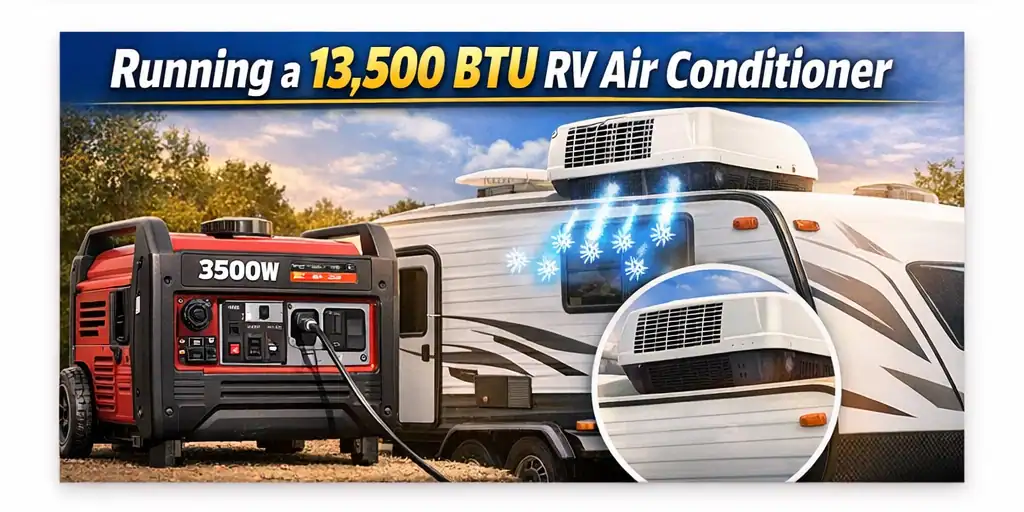
Yes — in most situations, a 3,500 watt generator can reliably run a 13,500 BTU RV air conditioner.
A typical 13,500 BTU unit requires:
- 1,500–1,800 running watts
- 2,500–3,000 startup watts
Since most 3,500 watt generators provide up to 3,500 surge watts and around 3,000–3,200 running watts, they are generally well-suited for this air conditioner size.
In moderate temperatures and at lower elevations, a 3,500 watt generator usually starts and runs a 13,500 BTU AC without issue — even while powering basic RV appliances like the refrigerator and converter.
However, performance may be affected if:
- Outdoor temperatures are very high
- The generator is operating at elevation
- Multiple high-demand appliances are used simultaneously
For the majority of travel trailers equipped with a 13,500 BTU air conditioner, a 3,500 watt generator provides a solid balance of power and portability.
Can It Run a 15,000 BTU RV Air Conditioner?
A 3,500 watt generator can sometimes run a 15,000 BTU RV air conditioner — but it operates much closer to its limit.
A typical 15,000 BTU RV AC requires:
- 1,700–2,000 running watts
- 3,000–3,500 startup watts
Because most 3,500 watt generators provide surge capacity up to 3,500 watts, they technically meet the startup requirement. However, there is very little margin for additional appliances or difficult conditions.
For a deeper breakdown of startup requirements, see can a generator run a 15,000 BTU RV air conditioner.
It may work reliably if:
- No other high-demand appliances are running
- Outdoor temperatures are moderate
- The generator is at lower elevation
- A soft start device is installed
It may struggle if:
- Temperatures are very hot
- The RV refrigerator and converter are drawing power
- You are camping at higher elevation
- The compressor startup surge is on the higher end
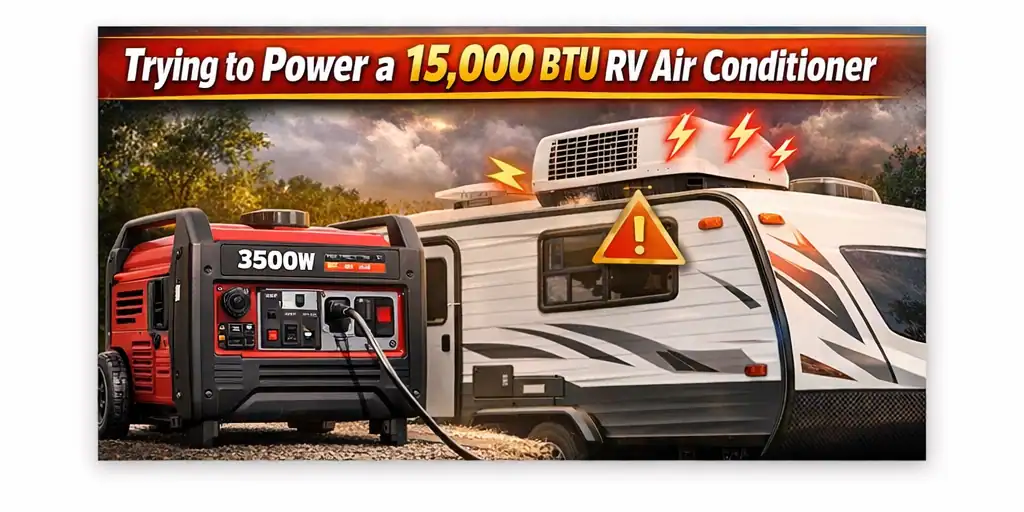
In many cases, a 3,500 watt generator can start and run a 15,000 BTU AC — but overload trips are more likely compared to a 4,000 watt unit.
If you want a more comfortable power margin, see our guide on can a 4000 watt generator run a travel trailer, where we break down performance differences in more detail.
3500W vs 3000W vs 4000W Comparison
Choosing between 3,000 watts, 3,500, and 4,000 watts comes down to how much power margin you want…
and how demanding your setup is.
Here’s how they compare in practical RV use:
🔹 3,000 Watts
- May run a 13,500 BTU AC in moderate weather
- Often struggles with 15,000 BTU units without a soft start
- Requires careful load management
- Lightest and most portable option
Best for smaller trailers and minimal appliance use.
see our full guide on can a 3000 watt generator run a travel trailer
If you’re considering smaller units, review can a 2000 watt generator run a travel trailer for limitations.
🔹 3,500 Watts
- Reliable for 13,500 BTU AC
- Can run a 15,000 BTU AC in favorable conditions
- Limited headroom when multiple appliances are active
- Balanced mix of power and portability
Best for mid-size travel trailers and moderate climates.
🔹 4,000 Watts
- Most reliable for 15,000 BTU AC
- Handles startup surges more comfortably
- Greater flexibility for running microwave or coffee maker
- Slightly heavier but more forgiving
Best for hot-weather camping and RV owners who prefer extra capacity.
If you’re still deciding, see our full breakdown of can a 3000 watt generator run a travel trailer and can a 4000 watt generator run a travel trailer for detailed real-world comparisons.
A 3,500 watt generator is a smart choice when you want more capability than a 3,000 watt unit — but don’t necessarily need the extra weight and fuel consumption of a 4,000 watt model.
This size is often ideal if:
- Your trailer has a 13,500 BTU air conditioner
- You camp primarily in moderate climates
- You want a balance between portability and performance
- You are comfortable managing appliance usage
It can also work for some 15,000 BTU setups, particularly if a soft start device is installed and you avoid running multiple high-demand appliances simultaneously.
However, if you:
- Frequently camp in very hot weather
- Operate at higher elevations
- Prefer not to think about load management
- Run a microwave or coffee maker while the AC is on
You may benefit from stepping up to a 4,000 watt generator for additional headroom.
For many mid-size travel trailers, 3,500 watts represents a practical middle ground that delivers reliable air conditioning without unnecessary excess capacity.
Recommended 3500W Generators for Travel Trailers
When choosing a 3,500 watt generator for a travel trailer, focus on models that provide strong surge capacity, inverter technology for clean power, and an RV-ready 30 amp outlet (TT-30R).
Below are the types of 3,500 watt generators that work well for RV use.
🔹 Best Overall 3,500W Class (Inverter Generator)
A 3,500 watt inverter generator offers quiet operation, stable power output, and sufficient surge capacity for most 13,500 BTU air conditioners.
Best for:
- Mid-size travel trailers
- Campgrounds with noise restrictions
- Balanced power and portability
Inverter models are especially popular with RV owners because they provide cleaner power for electronics and smoother AC startup.
🔹 Dual-Fuel Option (Gas & Propane)
Dual-fuel 3,500 watt generators allow you to run on gasoline or propane. This flexibility can be useful for extended camping trips.
Keep in mind:
- Propane output is usually slightly lower than gasoline
- Surge capacity may decrease slightly on propane
Still, many RVers appreciate the convenience of fuel choice.
🔹 Budget-Friendly Conventional Option
Some non-inverter 3,500 watt generators offer higher surge capacity at a lower cost. However, they are typically louder and less fuel-efficient.
These are best suited for:
- Occasional use
- Remote camping where noise is less of a concern
- Budget-conscious buyers
If you’re unsure whether 3,500 watts is enough for your specific setup, review our guide on what size generator for a 30 amp travel trailer for a broader sizing breakdown.
Frequently Asked Questions
Is 3,500 watts enough for a 30 amp travel trailer?
In many cases, yes. A 3,500 watt generator can run most 30 amp travel trailers, including models with a 13,500 BTU air conditioner. However, it operates close to the 3,600 watt maximum of a 30 amp system, so load management is important.
Can a 3,500 watt generator run a 15,000 BTU RV air conditioner?
It can in favorable conditions, especially if a soft start device is installed. However, startup surge for a 15,000 BTU unit can reach up to 3,500 watts, leaving little margin for other appliances.
How many running watts does a 3,500 watt generator provide?
Most 3,500 watt generators provide between 3,000 and 3,200 running watts, with surge capacity reaching 3,500 watts.
Is 3,500 watts better than 3,000 watts for RV use?
Yes. A 3,500 watt generator provides improved startup capability and more stability when running air conditioning compared to a 3,000 watt unit.
Is it worth upgrading from 3,500 watts to 4,000 watts?
If you frequently run a 15,000 BTU air conditioner, camp in hot climates, or prefer additional power headroom, upgrading to 4,000 watts can reduce overload risk and improve reliability
Final Verdict: Can a 3500 Watt Generator Run a Travel Trailer?
Yes — in many situations, a 3,500 watt generator can run a travel trailer, including models equipped with air conditioning.
For most RV owners:
- It reliably powers a 13,500 BTU air conditioner
- It can run a 15,000 BTU unit in favorable conditions
- It supports essential appliances with moderate load management
However, because a 3,500 watt generator typically provides around 3,000–3,200 running watts, it operates closer to the upper limit of a 30 amp system. That means careful appliance management may still be required, especially in hot weather or at higher elevations.
If you want more startup margin and flexibility, stepping up to 4,000 watts offers added reliability. If portability and weight matter most, 3,500 watts provides a practical middle ground between 3,000 and 4,000 watt options.
For many mid-size travel trailers, 3,500 watts strikes a strong balance between performance, efficiency, and portability.