
Introduction
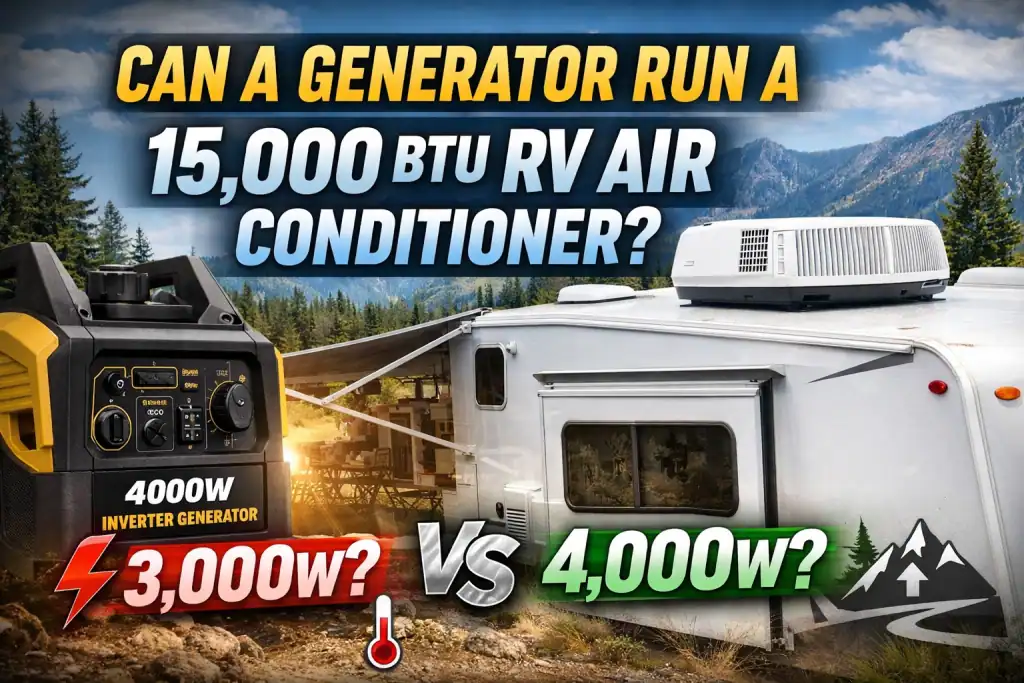
Yes — but only if the generator is properly sized to handle both the running and startup power requirements of the air conditioner.
A 15,000 BTU RV air conditioner typically requires between 1,700 and 2,000 running watts, but startup surge can briefly climb to 3,000–3,500 watts when the compressor kicks on. If your generator cannot handle that surge, it may trip overload protection or fail to start the unit entirely.
In this guide, we’ll break down exactly how many watts a 15,000 BTU RV AC uses, what size generator works reliably, whether 3,000 watts is enough, and why 4,000 watts is often the safer choice.
How Many Watts Does a 15,000 BTU RV Air Conditioner Use?
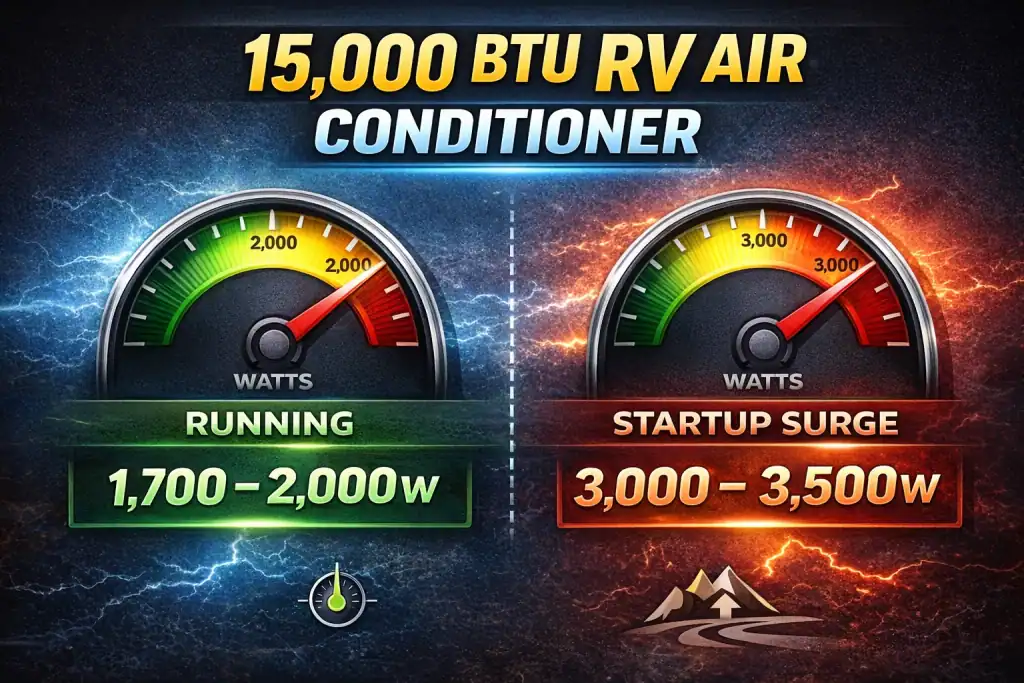
A typical 15,000 BTU RV air conditioner uses:
- 1,700 to 2,000 running watts
- 3,000 to 3,500 starting (surge) watts
The running watts represent the continuous power required to keep the air conditioner operating once the compressor is already running.
The starting watts are the brief spike of electricity needed when the compressor first turns on. This surge usually lasts only a second or two, but it is the most common reason generators overload.
Here’s a simple breakdown:
- Fan motor: 300–500 watts
- Compressor (running): 1,400–1,600 watts
- Total running load: ~1,700–2,000 watts
- Compressor startup surge: up to 3,500 watts
Because of this startup surge, choosing the correct generator size is critical. A generator that can handle the running load may still fail during compressor startup if it lacks sufficient surge capacity.
Starting Watts vs Running Watts Explained
Understanding the difference between starting watts and running watts is essential when powering a 15,000 BTU RV air conditioner with a generator.
Running watts are the steady amount of electricity required to keep an appliance operating once it is already on. For a 15,000 BTU RV AC unit, this is typically between 1,700 and 2,000 watts.
Starting watts (surge watts) refer to the brief spike in power required when the compressor first turns on. This surge can reach 3,000 to 3,500 watts, even though the unit does not draw that much power continuously.
Here’s why this matters:
If your generator can supply 2,000 running watts but only 2,500 surge watts, it may run the air conditioner once it’s started — but fail to handle the compressor startup.
Most inverter generators advertise both numbers:
- Running watts (continuous output)
- Peak or surge watts (short burst capacity)
When choosing a generator for a 15,000 BTU RV air conditioner, always make sure the surge rating exceeds the compressor’s startup requirement.
This is why many RV owners discover that a generator which “should work on paper” still struggles in real-world conditions.
What Size Generator Is Required for a 15,000 BTU RV AC?
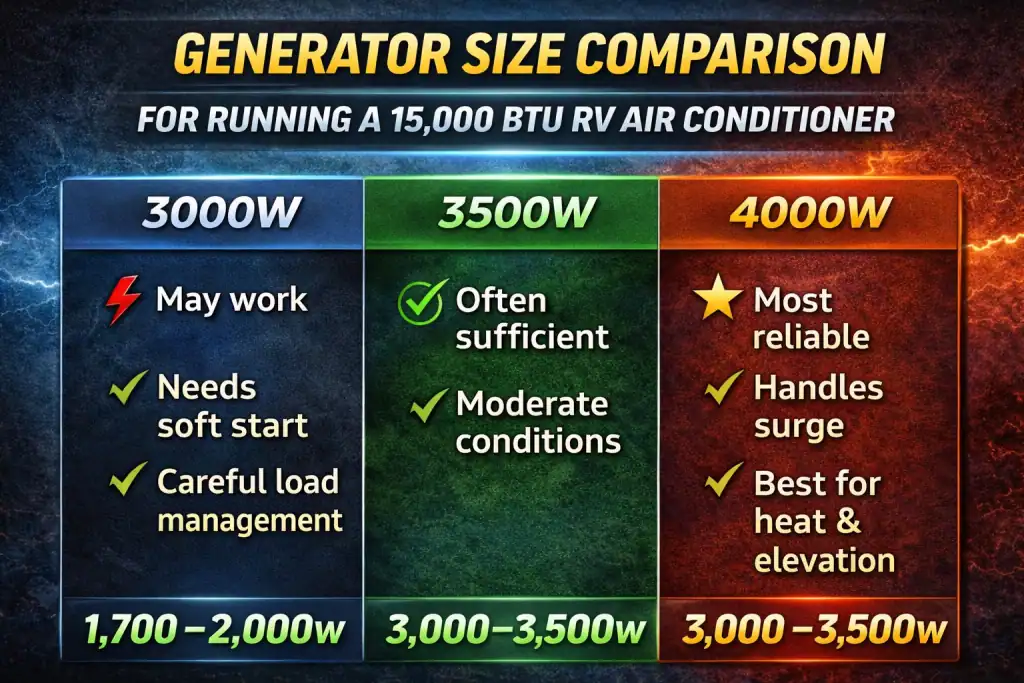
To reliably run a 15,000 BTU RV air conditioner, most RV owners need a generator rated between 3,500 and 4,000 watts.
Here’s why:
- Running load: 1,700–2,000 watts
- Startup surge: 3,000–3,500 watts
- Additional RV appliances: 300–1,000+ watts
Even if the air conditioner alone only needs around 2,000 running watts, your RV will likely be powering other essentials at the same time, such as:
- Refrigerator
- Converter/battery charger
- Interior lights
- Television or small electronics
Because of this combined load, the generator must handle both the AC startup surge and the background electrical demand.
Recommended Generator Size by Scenario
- 3,000 watts: May work with soft start and careful load management
- 3,500 watts: Often sufficient in moderate conditions
- 4,000 watts: Most reliable for consistent air conditioning performance
If you regularly camp in hot climates, operate at elevation, or want to avoid constant load management, a 4,000 watt generator is typically the safer choice.
Can a 3000 Watt Generator Run a 15,000 BTU RV Air Conditioner?
Sometimes — but it depends on the conditions.
Most 3,000 watt inverter generators provide around 2,800–3,000 running watts and slightly higher surge capacity. On paper, this appears close to the 3,000–3,500 watt startup requirement of a 15,000 BTU air conditioner.
However, in real-world conditions, a 3,000 watt generator is often operating at its limit when starting a 15,000 BTU unit.
It may work if:
- Outdoor temperatures are moderate
- No other major appliances are running
- The RV uses a soft start device
- The generator is in good condition
It may struggle if:
- Temperatures are very hot
- The RV refrigerator and converter are active
- You are camping at higher elevation
- The compressor startup surge is on the higher end
Many RV owners find that a 3,000 watt generator can start a 15,000 BTU AC with a soft start installed, but without one, overload trips are common.
If you’re considering this size, see our full breakdown on can a 3000 watt generator run a travel trailer for detailed appliance limitations and load management strategies.
Can a 4000 Watt Generator Run a 15,000 BTU RV Air Conditioner?
Yes — in most situations, a 4,000 watt generator can reliably run a 15,000 BTU RV air conditioner.
Most 4,000 watt inverter generators provide:
- 3,200–3,500 running watts
- Up to 4,000 surge watts
This gives enough capacity to handle the compressor startup surge while still powering other essential RV systems like the refrigerator and converter.
Compared to a 3,000 watt generator, a 4,000 watt model offers:
- Greater startup margin
- Reduced overload trips
- Better performance in hot weather
- Improved operation at elevation
For RV owners who depend on air conditioning — especially in summer climates — a 4,000 watt generator provides noticeable reliability improvements.
If you want a deeper breakdown of real-world appliance loads and comparisons, see our full guide on can a 4000 watt generator run a travel trailer.
For most campers running a 15,000 BTU air conditioner, 4,000 watts represents the most comfortable and dependable choice.
Does a Soft Start Make a Difference?
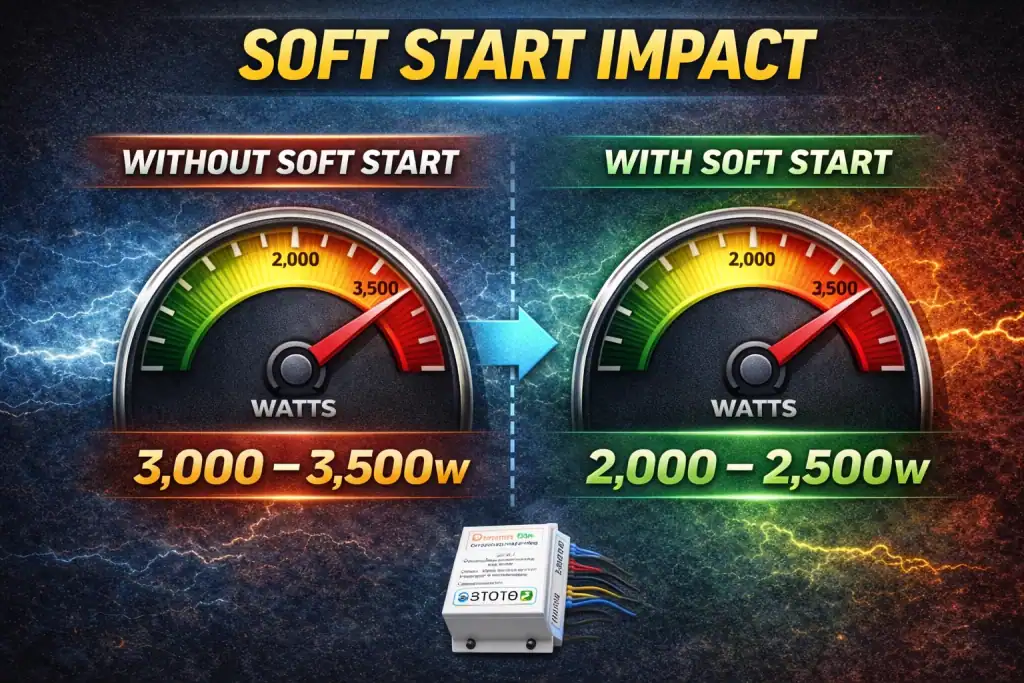
Yes — a soft start device can significantly reduce the startup surge of a 15,000 BTU RV air conditioner.
A standard compressor may require 3,000 to 3,500 watts during startup. A soft start system gradually ramps up power instead of allowing a sudden spike, often reducing startup demand by 30% to 40%.
With a soft start installed:
- Startup surge may drop closer to 2,000–2,500 watts
- A 3,000 watt generator becomes much more viable
- Overload trips are less likely
- Generator strain is reduced
For RV owners using a 3,000 watt inverter generator, installing a soft start can make the difference between frequent overload shutdowns and reliable air conditioning.
Even with a 4,000 watt generator, a soft start improves overall system stability and reduces stress on both the generator and the air conditioner compressor.
While not required, a soft start device is one of the most effective upgrades for RVers who rely on portable generators for air conditioning.
Factors That Affect Generator Performance (Heat & Elevation)
Even if a generator is technically large enough to run a 15,000 BTU RV air conditioner, real-world conditions can reduce its performance.
Two major factors are temperature and elevation.
🔹 High Temperatures
Hot weather increases both air conditioner demand and generator strain.
- The AC compressor works harder in extreme heat
- Startup surge may increase
- Generator efficiency can decrease
This is why a generator that works fine in 75°F weather may struggle in 95°F summer heat.
🔹 High Elevation
Generators lose power as elevation increases because thinner air reduces engine efficiency.
As a general rule:
- Expect approximately 3% to 3.5% power loss per 1,000 feet of elevation
For example:
- At 5,000 feet elevation, a 4,000 watt generator may effectively perform closer to 3,300–3,400 watts.
That loss can make the difference between reliable startup and overload trips.
Because of these factors, many RV owners choose slightly more generator capacity than their minimum calculated needs. The extra headroom helps ensure consistent performance in challenging conditions.
Recommended Generators for Running a 15,000 BTU RV Air Conditioner
When selecting a generator specifically to power a 15,000 BTU RV air conditioner, surge capacity and stable running watts are the most important factors.
Below are the generator size categories that typically perform best.
🔹 Best Overall Choice (4,000W Class)
A 4,000 watt inverter generator is the most dependable option for running a 15,000 BTU RV air conditioner. It provides enough surge capacity to handle compressor startup while still supporting other RV appliances.
Best for:
- Hot-weather camping
- 30 amp travel trailers
- Higher elevations
- Reduced overload risk
For most RV owners, this size offers the best balance of reliability and flexibility.
🔹 Balanced Option (3,500W Class)
A 3,500 watt generator can often handle a 15,000 BTU AC in moderate conditions, especially if a soft start device is installed.
Best for:
- Mild to moderate climates
- Careful load management
- RVers prioritizing lighter weight
🔹 Budget Option with Soft Start (3,000W Class)
A 3,000 watt inverter generator may work if:
- A soft start is installed
- No other major appliances are running
- Outdoor temperatures are moderate
Without a soft start, many 3,000 watt units struggle to reliably start a 15,000 BTU air conditioner.
If you’re comparing overall generator sizing for your trailer, see our guide on what size generator for a 30 amp travel trailer for a broader breakdown.
Frequently Asked Questions
How many watts does a 15,000 BTU RV air conditioner need to start?
A 15,000 BTU RV air conditioner typically requires between 3,000 and 3,500 watts at startup. This surge only lasts a few seconds but is the most demanding moment for a generator.
Will a 3,000 watt inverter generator run a 15,000 BTU AC?
It can in some situations, especially with a soft start installed and no other major appliances running. However, many 3,000 watt generators operate near their limit when starting a 15,000 BTU air conditioner.
Is 4,000 watts enough for a 15,000 BTU RV air conditioner?
Yes. In most conditions, a 4,000 watt generator provides enough surge and running capacity to start and operate a 15,000 BTU RV air conditioner reliably.
Does elevation affect generator performance with RV air conditioning?
Yes. Generators typically lose about 3% to 3.5% of power for every 1,000 feet of elevation. At higher elevations, a generator may struggle more during compressor startup.
Do I need a soft start to run a 15,000 BTU RV air conditioner?
A soft start is not required, but it significantly reduces startup surge and improves generator compatibility, especially for 3,000 watt models.
Final Verdict: Can a Generator Run a 15,000 BTU RV Air Conditioner?
Yes — a generator can run a 15,000 BTU RV air conditioner, but it must have enough surge capacity to handle compressor startup.
While the running load typically falls between 1,700 and 2,000 watts, startup demand can briefly reach 3,000 to 3,500 watts. That surge requirement is what determines whether a generator will start the unit reliably.
For most RV owners:
- A 3,000 watt generator may work with a soft start and careful load management
- A 3,500 watt generator is often sufficient in moderate conditions
- A 4,000 watt generator provides the most consistent and dependable performance
If you regularly camp in hot weather, operate at elevation, or want to avoid overload trips, choosing slightly more generator capacity is usually the safest approach.
When properly sized, a portable generator can run a 15,000 BTU RV air conditioner reliably and keep your travel trailer comfortable even during peak summer conditions.