
What Size Generator Do You Need for a 50 Amp RV?
50 amp RVs provide significantly more electrical capacity than smaller travel trailers and 30 amp RVs. This allows larger rigs to run multiple air conditioners, residential refrigerators, microwaves, and other high-power appliances.
However, many RV owners quickly realize something important:
A standard portable generator rarely produces enough power to fully replicate a 50 amp campground hookup.
Disclosure: This article contains affiliate links. If you purchase through these links, we may earn a commission at no additional cost to you.
In this guide, we’ll explain:
• How much power a 50 amp RV actually uses
• Why most RV generators are smaller than 50 amp service
• The best generator sizes for 50 amp RVs
• Real appliance power requirements
• Generator setups that work best for large RVs
How Much Power Does a 50 Amp RV Use?
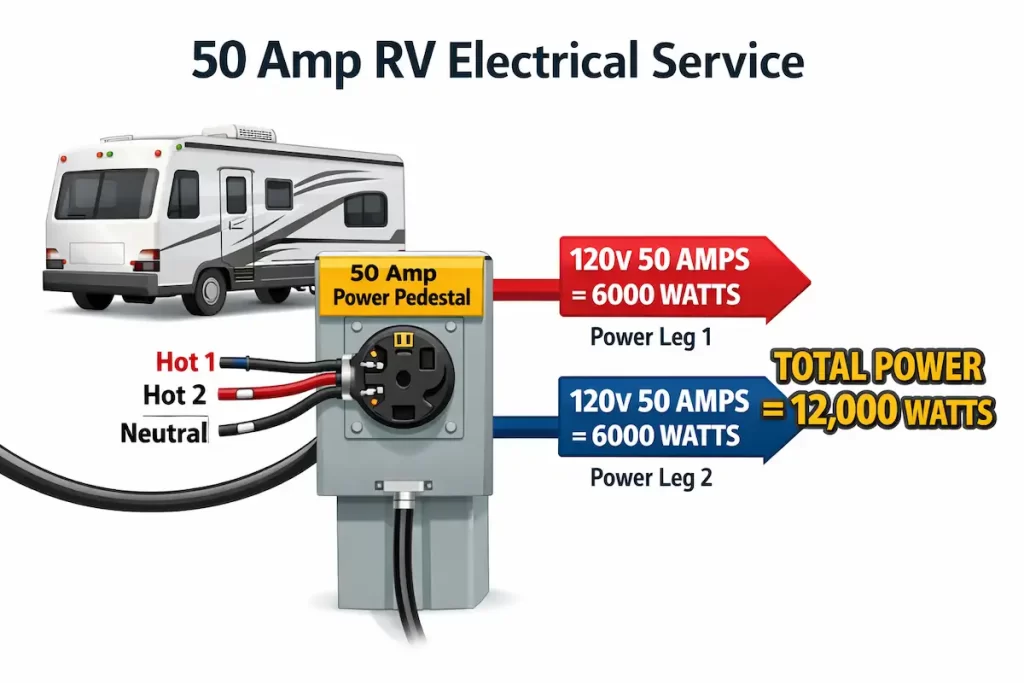
A 50 amp RV service actually provides up to 12,000 watts of power.
This surprises many RV owners.
Here’s why.
A 50 amp RV connection uses two separate 120-volt legs, each capable of delivering 50 amps.
Power calculation
P = V \times I
Each leg can provide:
120 volts × 50 amps = 6,000 watts
Since there are two legs, total available power is:
6,000 W + 6,000 W = 12,000 watts
This is why large fifth wheels and motorhomes can run multiple appliances at the same time.
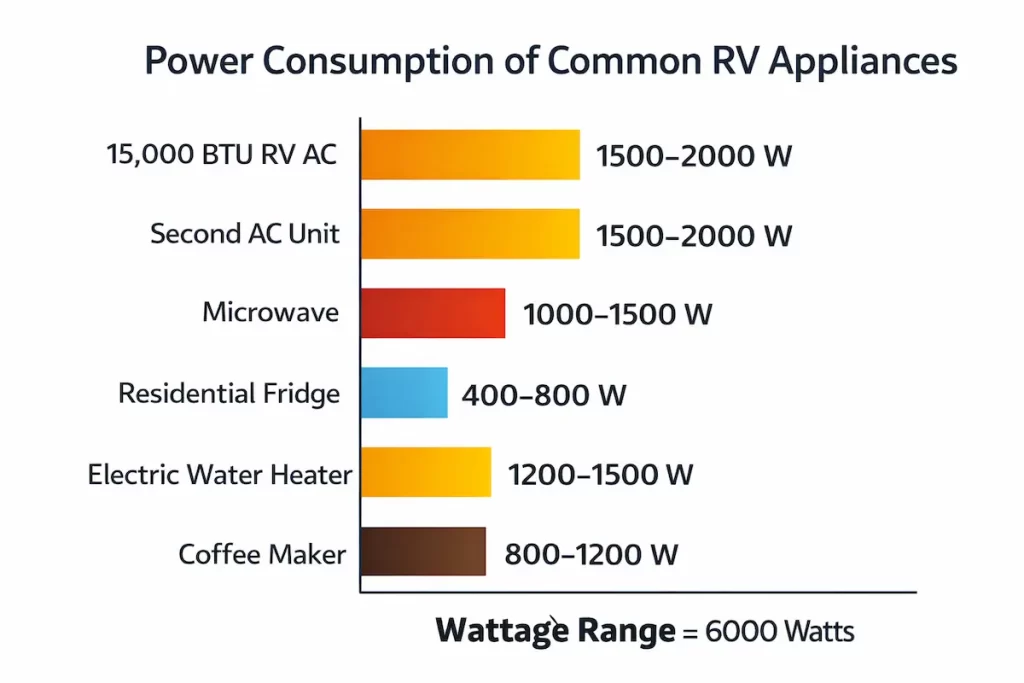
Typical appliances running in a 50 amp RV:
| Appliance | Running Watts |
|---|---|
| 15,000 BTU RV AC | 1500–2000W |
| Second AC unit | 1500–2000W |
| Microwave | 1000–1500W |
| Residential fridge | 400–800W |
| Electric water heater | 1200–1500W |
| Coffee maker | 800–1200W |
If several appliances run together, total power demand can easily exceed 5000–7000 watts.
If you’re unsure how to calculate generator wattage requirements, see our generator sizing guide that explains how to estimate power needs for RV appliances.
Why Most RV Generators Are Smaller Than 50 Amp Service
Even though a 50 amp RV can use 12,000 watts, most RV owners do not carry generators that large.
There are three main reasons.
1. Large generators are extremely heavy
A generator capable of producing 12,000 watts often weighs 250–350 pounds.
That makes portable use difficult.
2. Most RV owners don’t run everything at once
When using a generator, most RV owners manage power use.
For example:
• One AC unit instead of two
• Microwave used briefly
• Water heater switched to propane
This reduces generator requirements significantly.
3. Portable generators are typically smaller
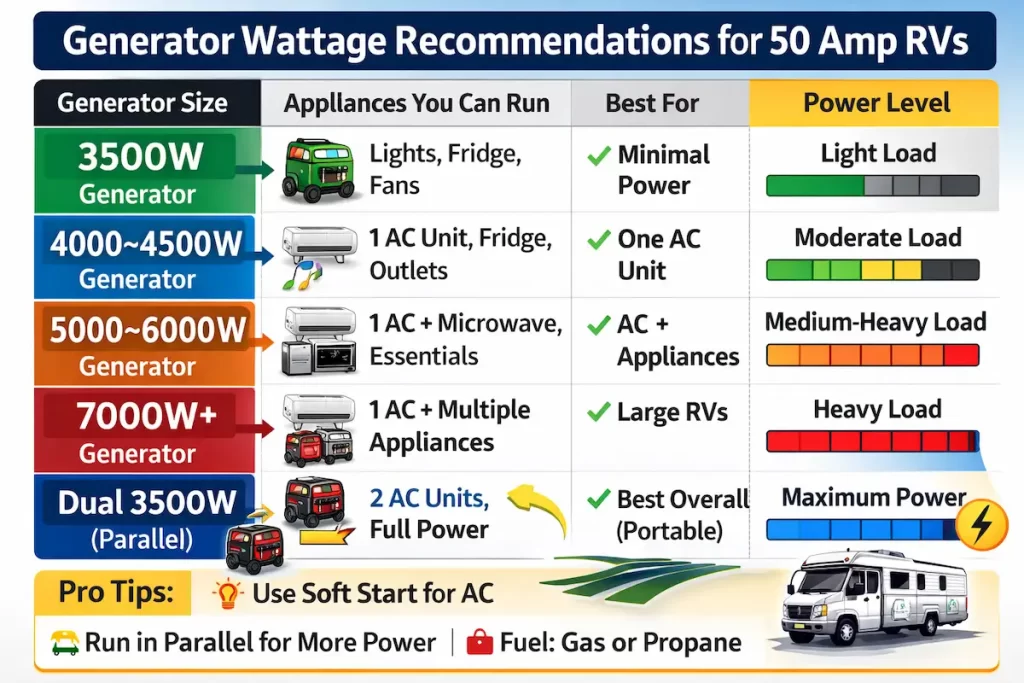
The most common portable generator sizes used with 50 amp RVs are:
| Generator Size | What It Can Power |
|---|---|
| 3500 watts | Light RV use |
| 4000 watts | One AC unit |
| 4500–5000 watts | One AC + appliances |
| 6000–7000 watts | Larger rigs |
| 2 generators in parallel | Best option for full use |
If you’re trying to run an air conditioner with a smaller generator, see our guide on whether a 3000 watt generator can run an RV air conditioner.
Generator Sizes That Work Best for 50 Amp RVs
4000–4500 Watt Generators
These generators are popular because they are still portable and can power:
• One 15k BTU air conditioner
• Refrigerator
• Battery charger
• Lights and outlets
However, they cannot run two AC units simultaneously.
5000–6000 Watt Generators
This size works well for larger RVs that want more flexibility.
You can typically run:
• One AC unit
• Microwave
• Refrigerator
• Small appliances
Startup surges still need to be considered.
7000+ Watt Generators
A generator in this range can power most RV systems including:
• One AC unit comfortably
• Microwave
• Water heater
• Kitchen appliances
However, these generators become much heavier and louder.
Best Generator Setup for 50 Amp RVs
Many experienced RV owners prefer dual generator setups.
Instead of one large generator, they run two smaller inverter generators in parallel.
Example:
• Two 3500W generators
• Total output: ~7000 watts
Advantages:
• Easier to transport
• Quieter operation
• Redundancy if one fails
• Better fuel efficiency
This setup often provides the best balance of power and portability.
Can a 50 Amp RV Run on a 4000 Watt Generator?
Yes — but with limitations.
A 4000-watt generator can run a 50-amp RV, but only if power use is managed.
Typically you can run:
• One air conditioner
• Refrigerator
• Battery charger
• Lights and outlets
But you may need to avoid running:
• Microwave
• Second AC unit
• Electric water heater
This is why many RV owners install soft start kits on their AC units.
These reduce startup surge power.
Soft Start Systems Reduce Generator Size Requirements
One of the biggest challenges when running a 50 amp RV on a portable generator is air conditioner startup surge.
A typical 15,000 BTU RV air conditioner may only use 1500–2000 watts while running, but it can require 3000–3500 watts for a split second during startup.
That surge is what causes many generators to overload.
Soft start systems solve this problem.
What a Soft Start Does
A soft start module gradually ramps up power to the AC compressor instead of allowing a sudden spike.
This reduces startup power requirements by up to 60–70%.
Benefits include:
• Allows smaller generators to start RV AC units
• Reduces generator overload shutdowns
• Protects the AC compressor
• Makes boondocking easier
Many RV owners install soft starts so they can run a 15,000 BTU AC on a 3000–4000 watt generator.
If you’re trying to run an AC with a smaller generator, see our guide on using a 4000-watt generator for an RV air conditioner.
Popular RV Soft Start Systems
Micro-Air EasyStart
Pros
- Most popular RV soft start
- Works with many AC units
- Reduces startup surge dramatically
Best for:
RV owners running generators under 4000 watts.
SoftStartRV
Pros
- Designed specifically for RV AC units
- Easy install kits available
- Good support documentation
Best for:
RVers who want the easiest installation.
Quick Generator Size Recommendations
Quick Generator Size Recommendations
| RV Usage | Generator Size |
|---|---|
| Minimal power use | 3500W |
| One AC unit | 4000–4500W |
| AC + appliances | 5000–6000W |
| Large RV loads | 7000W+ |
| Best portable setup | Two 3500W generators |
Below are answers to common questions RV owners ask when choosing the right generator for a 50-amp RV.
Frequently Asked Questions
Can you run a 50-amp RV on a generator?
Yes, a 50 amp RV can run on a generator. However, most portable generators produce less power than a full 50 amp hookup. Many RV owners use generators between 4000 and 7000 watts and manage appliance usage while boondocking.
How many watts does a 50 amp RV use?
A 50 amp RV service can provide up to 12,000 watts of power. This comes from two separate 120-volt legs that each provide 50 amps of electricity.
However, most RVs rarely use the full capacity unless multiple air conditioners and appliances are running at the same time.
Can a 4000 watt generator run a 50 amp RV?
Yes, a 4000 watt generator can run a 50 amp RV, but with some limitations. Typically, it can power one air conditioner, the refrigerator, lights, and small appliances. Larger appliances like microwaves or water heaters may need to be used one at a time.
Do you need a 50 amp generator for a 50 amp RV?
No. A generator capable of producing 12,000 watts would be required to fully match a 50 amp campground hookup, but most RV owners use smaller portable generators and simply manage their power usage.
What is the best generator setup for a 50 amp RV?
Many RV owners prefer running two inverter generators in parallel. For example, two 3500-watt generators can produce around 7000 watts of power, which is enough to run most RV appliances while remaining portable and relatively quiet.
Final Thoughts
Although a 50 amp RV can theoretically use 12,000 watts, most RV owners successfully power their rigs with generators between 4000 and 7000 watts.
Choosing the right generator depends on:
• Number of air conditioners
• Appliance usage
• Noise tolerance
• Portability needs
For many RVers, the best balance of power and portability comes from dual inverter generators running in parallel.
Always follow basic generator safety tips when operating a portable generator near your RV, especially when camping or boondocking.
Related Generator Size Guides
If you’re still deciding what size generator you need for your RV or travel trailer, these guides can help: